

Vincent van Gogh (1853–1890) was a Dutch post-impressionist painter, the author of The Starry Night and the Sunflowers series, whose work gained wide recognition only after his death. He took up art at 27, after working as an art dealer, a teacher and a lay preacher, and painted for just ten years. His life combined intense work, financial dependence on his brother Theo and a mental illness that ended with his suicide at the age of 37.
Vincent van Gogh at a glance:
- Dutch post-impressionist painter, born on 30 March 1853 in Zundert in the Netherlands, died on 29 July 1890 in Auvers-sur-Oise, France.
- More than 850 paintings and almost 1,300 works on paper survive from his ten-year career.
- Cut off his entire left ear in Arles on 23 December 1888, during a mental crisis that followed a quarrel with Paul Gauguin.
- His auction record is $117.2m, paid at Christie’s in New York in November 2022 for Verger avec cyprès (‘Orchard with Cypresses’, 1888).
Who was Vincent van Gogh?
Vincent van Gogh was a Dutch painter counted among the post-impressionists. He was born on 30 March 1853 in Zundert, a village in North Brabant, the eldest son of Theodorus van Gogh, a minister of the Dutch Reformed Church, and Anna Cornelia Carbentus. Five younger siblings followed, and he was closest to his brother Theo, born in 1857. The family often went walking in the countryside around Zundert, which gave him a lasting love of nature, and at 11 he moved from the village school to a boarding school in Zevenbergen.

He came to painting late and worked as an artist for only about ten years. He started with dark, earthy scenes of rural life and finished with canvases of saturated colour and thick paint, the paintings he is known for today. Wide recognition came only after his death.
How did Van Gogh become a painter?
Van Gogh found his calling at 27, after trying his hand as an art dealer, a teacher and a lay preacher, and it was his brother Theo who first suggested that he become an artist. In 1869, aged 16, he started as a trainee at the art dealer Goupil & Cie in The Hague, a post found for him by his uncle. In 1873 the firm sent him to its London branch and later to Paris, and in 1876 it dismissed him.
He went back to England, first as an unpaid assistant teacher at a boys’ boarding school in Ramsgate and then in a salaried post at a school run by a vicar in Isleworth, near London. In January 1877 he took a job in a bookshop in Dordrecht, and a few months later he moved to Amsterdam to prepare for the entrance exam in theology. He gave up after a year and went to the Borinage, a coal-mining region in Belgium, as a lay preacher, but his contract there was not renewed.

In October 1880 he moved to Brussels to work on his drawing, and from 1881 Theo supported him financially. He drew first and turned to oil paint later. In Nuenen, where he lived with his parents from December 1883, he made studies of local peasants, and in April and May 1885 he painted The Potato Eaters, a scene with several figures meant to prove that he was becoming a capable figure painter.
He was largely self-taught. In January 1886 he enrolled at the art academy in Antwerp, but its drawing classes were too traditional for him, and after moving in with Theo in Paris he took lessons in the studio of the painter Fernand Cormon.
Where did Van Gogh paint his best-known works?
Most of the paintings Van Gogh is known for come from the last years of his life, which he spent in Paris, Arles, Saint-Rémy-de-Provence and Auvers-sur-Oise. In Paris, from 1886 to 1888, he saw the work of the Impressionists, lightened his palette and tried out their broken brushstrokes as well as the dotted technique of the Neo-Impressionists. He also discovered Japanese woodblock prints. He bought more than 600 of them, at first with the idea of trading in them, and they had a decisive influence on the direction of his art.
In February 1888 he moved to Arles in the south of France. He hoped to found a ‘Studio of the South’ there with other painters and settled in the Yellow House, but only Paul Gauguin came, arriving on 23 October 1888 at Van Gogh’s invitation and with Theo’s financial help. In Arles Van Gogh painted the Sunflowers series, The Bedroom and his night scenes of the town’s cafés.
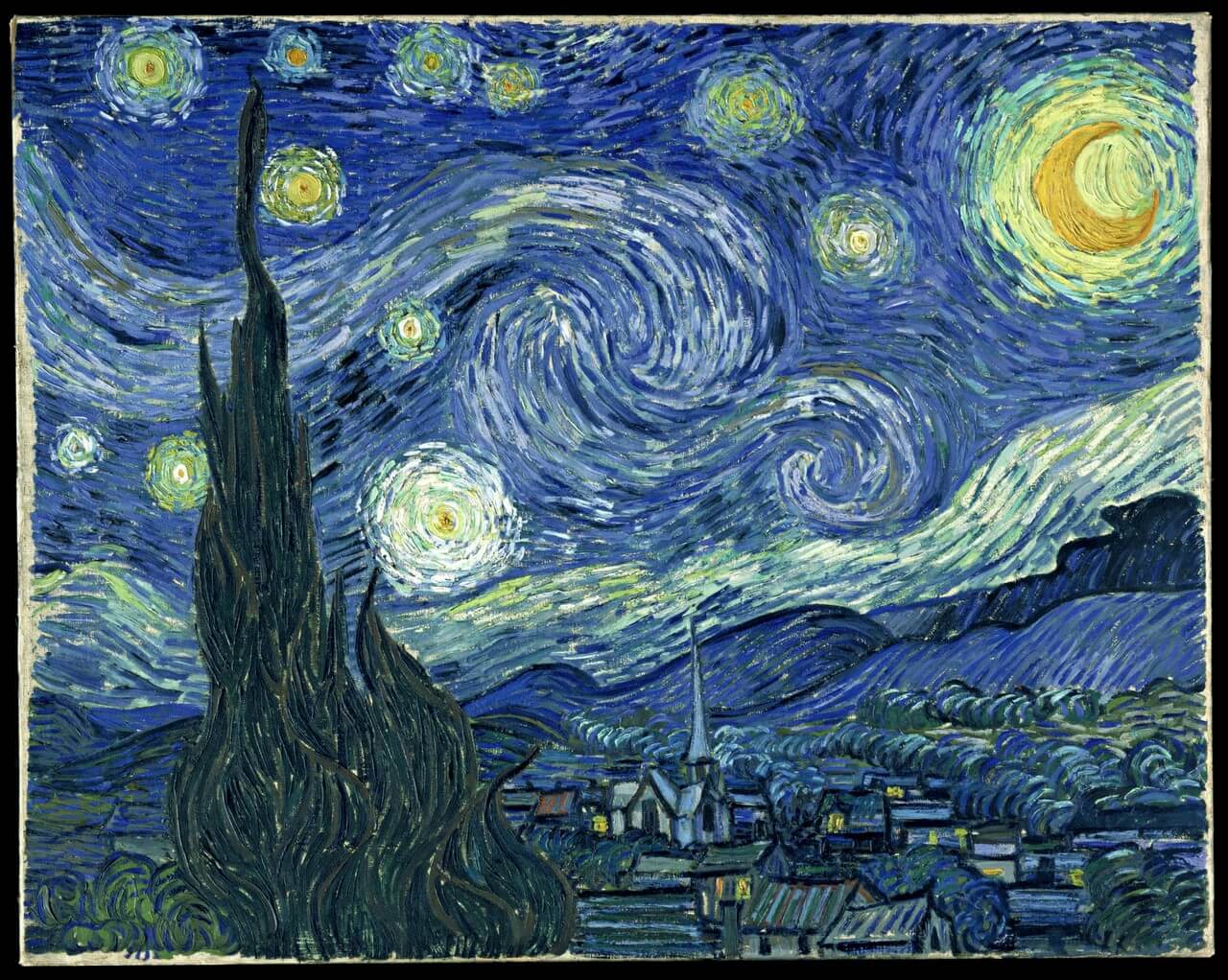
After the crisis of December 1888 and further attacks, he voluntarily entered the Saint-Paul-de-Mausole asylum in Saint-Rémy-de-Provence on 8 May 1889 and stayed there for a year. He painted the asylum garden and the view from his window, among them Irises and The Starry Night. In May 1890 he moved to Auvers-sur-Oise, north of Paris, under the care of Dr Paul Gachet, and in the just over two months he spent there he completed nearly a painting a day.
Did Van Gogh have a wife or children?
Van Gogh never married and had no children. In 1881, while staying with his parents in Etten, he fell in love with his cousin Kee Vos-Stricker, a recently widowed mother of a young son. She turned down his repeated proposals with the words ‘No, nay, never’.
In January 1882 in The Hague he met Sien Hoornik, a former prostitute who was pregnant and had been abandoned by the child’s father. She moved in with him together with her five-year-old daughter, Maria, and her newborn son, Willem, and she and her family became his most frequent models in The Hague. They parted in the autumn of 1883, when he left for Drenthe in the north of the Netherlands.
What role did Theo van Gogh play?
Theo, four years younger and himself employed by Goupil, was Vincent’s main financial support and closest correspondent. From 1881 he paid for his brother’s living costs, and in return Vincent sent him almost all of his paintings and drawings.

The brothers wrote to each other from September 1872 until Vincent’s death. Of the 820 surviving letters by Vincent, 651 are addressed to Theo, while only 39 of Theo’s letters to him have survived. This correspondence is the fullest record of what Van Gogh thought about his work, his colours and his plans. Theo died on 25 January 1891, six months after his brother.
Why did Van Gogh cut off his ear?
Van Gogh cut off his left ear on the evening of 23 December 1888 in Arles, in a state of acute mental crisis that followed a heated argument with Paul Gauguin. When Dr Félix Rey, who treated him, asked about his motive, Van Gogh said it was a purely personal matter.
The two painters had shared the Yellow House for two months, and living together was tense. Around 12 December Gauguin wrote to Theo that he had decided to leave, then stayed on. On 23 December, after a row, Gauguin spent the night in a hotel. Van Gogh cut off his whole ear with a razor, wrapped it in paper and took it to a prostitute in the town.
He was taken to the hospital in Arles, where the chief physician recorded an attack of acute mania with generalised delirium. Gauguin left for Paris with Theo, who had hurried to Arles, and the two painters never saw each other again, although they went on writing to each other.
What illness did Van Gogh have?
The doctors who treated Van Gogh in Arles and Saint-Rémy concluded that he had a form of epilepsy. Medical literature has since proposed more than a dozen other explanations, among them schizophrenia, manic-depressive disorder, borderline personality disorder, syphilis, alcoholism, a metabolic disorder and even sunstroke.
His father had written that Vincent was always inclined to melancholy. In Arles Dr Rey linked his first crisis to his way of life: a great deal of alcohol, coffee and tobacco, and poor food.

In 2016 the Van Gogh Museum examined his illness in the exhibition and symposium On the Verge of Insanity: Van Gogh and his Illness. Four of the medical specialists involved published their own study in 2020, led by Willem Nolen of the University Medical Center Groningen. They concluded that Van Gogh most likely had several overlapping conditions: a mood disorder, probably bipolar, with traits of borderline personality disorder, made worse by heavy drinking and poor nutrition. They judged schizophrenia highly improbable and could not rule out focal epilepsy.
How did Van Gogh die?
Van Gogh died in the early hours of 29 July 1890 in his room at the Auberge Ravoux in Auvers-sur-Oise, two days after shooting himself in the chest. He was 37.
On 27 July he went out to paint as usual and did not come back for dinner. He returned to the inn around nine in the evening, badly wounded, and when the innkeeper, Arthur Ravoux, asked what he had done, he replied: ‘I tried to kill myself.’ The bullet had lodged too deep to be removed without serious risk.
Theo was told the next morning and hurried from Paris to his brother’s bedside, which he did not leave. The brothers were able to talk. Theo later wrote that Vincent wanted to die and recorded one of his last sentences: ‘La tristesse durera toujours’ (‘The sadness will last forever’).
What makes Van Gogh’s style recognisable?
Van Gogh’s style rests on saturated colour, paint laid on in thick, visible layers and bold outlines. The thick application of paint, known as impasto, gives his canvases a raised surface: in Irises the ridges of paint stand out clearly from the canvas.
He liked to set strong colours against each other. In The Night Café he tried, in his own words, to express ‘the terrible human passions’ with red and green, and while painting a café terrace in Arles at night he noted that the yellow and orange of gaslight made the blue of the sky more intense.
Japanese woodblock prints taught him bold outlines, flat areas of colour and unusual cropping. Almond Blossom borrows its subject, its outlines and the placement of the branches from Japanese printmaking, and Van Gogh himself wrote that all his work was based to some extent on Japanese art.

His subjects fall into a few groups: landscapes with wheatfields, gardens and night skies, portraits and self-portraits, scenes of everyday life, and still lifes, among them the sunflowers and irises. In the Netherlands he painted peasants and the hard reality of rural life.
What are Van Gogh’s most famous paintings and where can you see them?
Van Gogh’s best-known paintings include The Starry Night (1889), the Sunflowers series (1888–1889) and Almond Blossom (1890). The Starry Night, painted in June 1889, shows the view from the east-facing window of his room at the Saint-Rémy asylum, with a village added from imagination. He painted it in his studio during the day. In Arles in 1888 and 1889 he painted five large canvases of sunflowers in a vase. Almond Blossom, with white blossom against a blue sky, was a present for Theo and his wife, Jo, after the birth of their son, Vincent Willem, in January 1890.

Other key works, in the order they were painted:
- The Old Church Tower at Nuenen (‘The Peasants’ Churchyard’) (1885): the ruined tower of Nuenen’s old church above a peasant graveyard. Van Gogh wanted to show how peasants had been laid to rest for centuries among the fields they had worked. The tower was demolished soon afterwards.
- The Potato Eaters (1885): a peasant family sharing a meal, painted in dark, earthy tones.
- The Harvest (1888): the dry, flat plain around Arles in June, a picture Van Gogh counted among his finest.
- The Bedroom (1888): his room in the Yellow House, painted in October 1888. He repeated the composition twice in 1889.
- Terrace of a Café at Night (Place du Forum) (1888): a gas-lit café terrace in Arles, painted on the spot around 16 September 1888, with the stars placed as they appeared over the town that night.
- The Night Café (1888): the interior of an all-night café on Place Lamartine in Arles, painted in clashing reds and greens.
- Self-Portrait with Bandaged Ear (1889): painted in January 1889, a week after he left hospital. He worked from a mirror, so the bandage appears on the right.
- Irises (1889): irises in the asylum garden at Saint-Rémy, painted from nature in May 1889, within weeks of his arrival.
- Dr Paul Gachet (1890): the doctor seated with his head resting on his hand, painted in June 1890 in Auvers, in two versions.
- Wheatfield with Crows (1890): a wheatfield under a stormy sky with a flock of crows, painted in July 1890 in an elongated, double-square format.
| Painting | Year | Where to see it |
|---|---|---|
| The Old Church Tower at Nuenen | 1885 | Van Gogh Museum, Amsterdam |
| The Potato Eaters | 1885 | Van Gogh Museum, Amsterdam |
| Sunflowers | 1888–1889 | National Gallery, London; Van Gogh Museum, Amsterdam; other versions in Munich, Philadelphia and Tokyo |
| The Harvest | 1888 | Van Gogh Museum, Amsterdam |
| The Bedroom | 1888–1889 | Van Gogh Museum, Amsterdam; Art Institute of Chicago; Musée d’Orsay, Paris |
| Terrace of a Café at Night (Place du Forum) | 1888 | Kröller-Müller Museum, Otterlo |
| The Night Café | 1888 | Yale University Art Gallery, New Haven |
| Self-Portrait with Bandaged Ear | 1889 | Courtauld Gallery, London |
| Irises | 1889 | J. Paul Getty Museum, Los Angeles |
| The Starry Night | 1889 | Museum of Modern Art (MoMA), New York |
| Almond Blossom | 1890 | Van Gogh Museum, Amsterdam |
| Dr Paul Gachet | 1890 | Musée d’Orsay, Paris (second version) |
| Wheatfield with Crows | 1890 | Van Gogh Museum, Amsterdam |
The Van Gogh Museum in Amsterdam holds the largest collection of his work, with more than 200 paintings, 500 drawings and more than 750 letters. Tickets are sold online only, with a set entry time, including for visitors who enter free. In 2026 an adult ticket costs €25, and entry is free for visitors under 18.
How many paintings did Van Gogh make and what are they worth?
In his ten years as an artist Van Gogh produced more than 850 paintings and almost 1,300 drawings, watercolours, sketches and prints, and the most expensive of his canvases has sold for more than $100m.

His auction record is $117.2m, paid at Christie’s in New York on 9 November 2022 for Verger avec cyprès, a blossoming orchard painted in Arles in April 1888 and sold from the collection of the Microsoft co-founder Paul Allen.
In 1990 the first version of his portrait of Dr Gachet sold at Christie’s in New York for $82.5m, at the time a world record for a painting at auction. Adjusted for US inflation, that price is equivalent to just over $180m, well above the 2022 record.
Why did Van Gogh become famous only after his death?
Recognition began in the last year of Van Gogh’s life and grew after his death through the efforts of his sister-in-law, Jo van Gogh-Bonger. In January 1890 the critic Albert Aurier praised his work in the Mercure de France, and that same month his paintings were shown at the Les XX exhibition in Brussels.
Jo, Theo’s widow, inherited the paintings and set out to make them known through exhibitions and sales. In 1905 she organised a retrospective at the Stedelijk Museum in Amsterdam with more than 480 works, between 1891 and 1925 she sold nearly 200 of his works, and in 1914 she published his letters to Theo. The Van Gogh Museum, which calls her ‘the woman who made Vincent famous’, opened in 1973 thanks to her son, Vincent Willem van Gogh, who kept the family collection together.

His colour and brushwork influenced the next generation of painters, including the Fauvists in France and the German Expressionists. Tate describes fauvism as an extreme extension of Van Gogh’s post-impressionism, and the Brücke painter Max Pechstein later called him the father of them all.
Van Gogh: myths and facts
Several of the best-known stories about Van Gogh do not match the documents.
- ‘He cut off only his earlobe.’ He cut off the whole ear. In 1930 Dr Félix Rey drew the injury for the American writer Irving Stone. The sketch, found by the researcher Bernadette Murphy, went on show at the Van Gogh Museum in 2016.
- ‘He sold only one painting.’ He sold several. His first commission came from his uncle Cor, and he often traded work for food or painting materials.
- ‘He was murdered.’ A 2011 biography by Steven Naifeh and Gregory White Smith suggested that a teenager had shot him. The Van Gogh Museum considers the theory entirely unfounded: Van Gogh himself said that he had tried to take his own life.
- ‘Wheatfield with Crows was his last painting.’ It dates from July 1890, a few weeks before his death, but his last painting was Tree Roots, now also in the Van Gogh Museum.
Vincent van Gogh – frequently asked questions
Was Van Gogh an impressionist?
No. He is counted among the post-impressionists, although in Paris he adopted the lighter palette and broken brushstrokes of the Impressionists.
What do Van Gogh’s Sunflowers symbolise?
Van Gogh wrote that his sunflower paintings expressed ‘gratitude’. He hung the first two in Gauguin’s room in the Yellow House in Arles.
Who was Dr Gachet?
Dr Paul Gachet was the physician in Auvers-sur-Oise who monitored Van Gogh’s health in his last months, a doctor who specialised in melancholy and nervous illnesses. Van Gogh told Gauguin that his portrait of Gachet showed ‘the heart-broken expression of our time’.
Where is Van Gogh buried?
In the cemetery at Auvers-sur-Oise, where he was buried on 30 July 1890. In 1914 Jo van Gogh-Bonger had Theo reinterred in a grave beside his brother’s.
Van Gogh’s yellows and cobalt blues work on canvas, but in an interior they call for decisions about light, background and neighbouring materials, because an intense yellow or cobalt can dominate a whole room. When a scheme is built around a palette this strong, it pays to plan it with a professional. Find architects, interior designers and interior photographers in the PLNDesign directory.
See also:
- Wassily Kandinsky: life, colour theory and famous paintings
- Rafal Olbinski: the Polish poster artist of poetic surrealism