

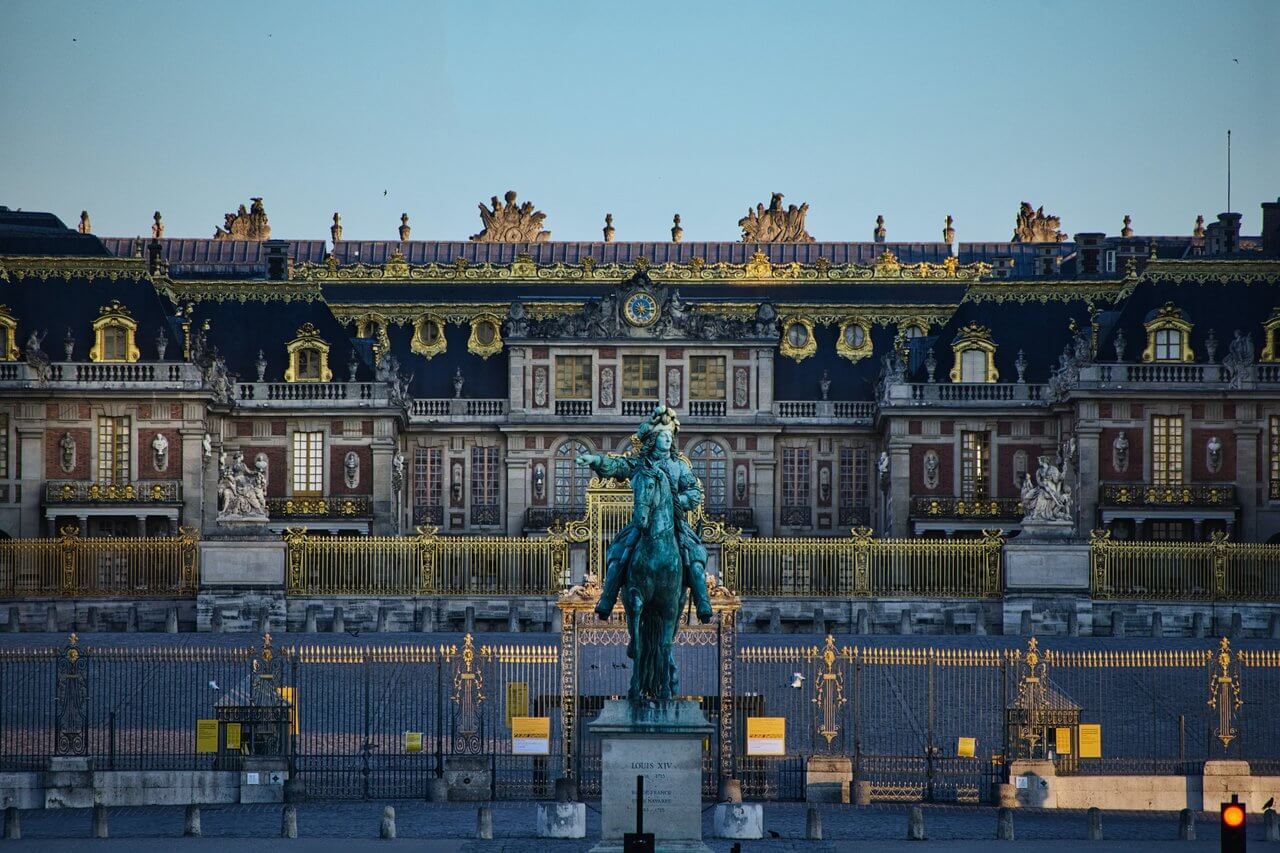
The Palace of Versailles is the former residence of the kings of France, in the town of Versailles, 17 kilometres west-south-west of central Paris. Louis XIV made it the seat of the court and government in 1682, and it remained the principal royal residence until a crowd from Paris forced Louis XVI and Marie Antoinette to leave in October 1789. The palace, gardens, park and Estate of Trianon together cover more than 800 hectares, and the site has been a UNESCO World Heritage Site since 1979.
Palace of Versailles at a glance:
- Seat of the French monarchy: Louis XIV moved the court and government here on 6 May 1682, and the royal family left on 6 October 1789.
- 2,300 rooms on 63,154 square metres: the palace grew through building campaigns led by Louis Le Vau and Jules Hardouin-Mansart, with interiors by Charles Le Brun and gardens by André Le Nôtre.
- The Hall of Mirrors: a 73-metre gallery lined with 357 mirrors, where the German Empire was proclaimed in 1871 and the Treaty of Versailles was signed in 1919.
- A Passport ticket in 2026: €35 from April to October and €25 from November to March, with €3 off for nationals and residents of the European Economic Area.

What is the Palace of Versailles famous for?
Versailles is famous as the seat of the French monarchy from Louis XIV to Louis XVI, for the Hall of Mirrors and for the formal gardens of André Le Nôtre. Several turning points in European history also took place here. The Estates-General opened in Versailles on 5 May 1789, and on 6 October that year a crowd from Paris carried Louis XVI and Marie Antoinette off to the capital, which moved the centre of power back to Paris.
On 18 January 1871, after France’s defeat in the Franco-Prussian War, the Prussian king Wilhelm I was proclaimed German Emperor in the Hall of Mirrors. Almost half a century later, the French prime minister Georges Clemenceau chose the same room for the signing of the Treaty of Versailles, which ended the First World War, on 28 June 1919. Today the estate is one of the most visited cultural sites in France: it received 8.4 million visitors in 2025, the same number as in 2024.
How was the Palace of Versailles built?
Versailles grew from a hunting lodge built for Louis XIII in 1623 into a royal palace through the building campaigns that Louis XIV started in 1661 and continued until the end of his reign. The land belonged to the Gondi family, who invited Louis XIII to hunt in the surrounding forests. The king bought part of the estate in 1623 and the rest in 1632, and between 1631 and 1634 the architect Philibert Le Roy replaced the first lodge with a small château of brick and stone.
Louis XIV hunted at Versailles in the 1650s but turned his attention to it only in 1661. On 17 August that year he attended a lavish fête given by Nicolas Fouquet, his Superintendent of Finances, at the Château de Vaux-le-Vicomte, and in September Fouquet was imprisoned. The king then recruited the team behind Vaux: the architect Louis Le Vau, the gardener André Le Nôtre and the painter Charles Le Brun. Jean-Baptiste Colbert, who replaced Fouquet, managed the craftsmen working for the crown.

Le Vau’s first addition kept the old château and, from 1668, enclosed it on the garden side in a new building, known as the envelope. After the Treaty of Nijmegen in 1678, Jules Hardouin-Mansart led the third building campaign (1678–1684), which added the Hall of Mirrors, the north and south wings and the Orangery and gave the palace much of the appearance it has today. Louis XIV moved the court and the government to Versailles on 6 May 1682, while building work was still going on. The Royal Chapel was finished in 1710, near the end of his reign, and the Royal Opera was inaugurated under Louis XV in 1770.
The Revolution ended Versailles’ role as a royal residence. Its furniture and decoration were dispersed or partly destroyed, but the state kept the buildings, and in 1837 King Louis-Philippe opened the palace as a museum dedicated to ‘all the glories of France’. Over many decades since then, the museum has been reconstituting the interiors and their furnishings.
What does the Palace of Versailles look like?
The palace follows the principles of French classicism: a symmetrical plan, colonnaded façades and sculpture drawn from antiquity and mythology. On the town side, three wide avenues converge on the Place d’Armes, a former parade ground, and a sequence of courtyards leads inwards: the Honour Courtyard between the Ministers’ wings, the Royal Courtyard and, at the centre, the Marble Courtyard, framed by the brick-and-stone façades of Louis XIII’s château. Hardouin-Mansart crowned the roofline of the old château with elaborate dormer windows and gilded lead ornaments in 1679–1681.
On the garden side, Le Vau’s first design, which UNESCO describes as still strongly Italianate, included an open terrace between the king’s and the queen’s apartments. From 1678 Hardouin-Mansart replaced the terrace with the Hall of Mirrors and extended the garden front with the north and south wings, introducing what UNESCO calls a sober, large-scale and uniform architecture, now inseparable from the memory of Louis XIV. Today the palace has 2,300 rooms over 63,154 square metres.
What is there to see inside the Palace of Versailles?
Inside the palace, the main stops are the Hall of Mirrors, the King’s State Apartment, the Queen’s Apartment, the Royal Chapel and the Royal Opera, while the Gallery of Coaches in the Great Stables is free to enter. The Hall of Mirrors was built in 1678–1684 to a design by Hardouin-Mansart on the site of the garden terrace. The gallery is 73 metres long, and its 17 windows face 17 arches set with 357 mirrors, 21 in each arch. Their number and size demonstrated that the new French manufacture could rival Venice’s monopoly on mirror making. Charles Le Brun painted the vaulted ceiling with 30 compositions on the history of Louis XIV from 1661 to the peace treaties of Nijmegen, and he also decorated the War Room and the Peace Room at either end. Courtiers crossed the gallery every day and used it as a place to wait and meet, and for exceptional receptions the king’s throne stood on a platform near the Peace Room.
The King’s State Apartment is a sequence of seven rooms, decorated in 1671–1680, where the king carried out his official acts. The rooms are named Hercules, Abundance, Venus, Diana, Mars, Mercury and Apollo. The Diana Room served as a billiards room during evening gatherings, with two tiers of seating for courtiers watching the king play, and it holds Bernini’s 1665 bust of Louis XIV. The Mars Room was the guard room, the Mercury Room was originally the state bedchamber, and the Apollo Room was the throne room from 1682. Much of the furniture in these rooms, including the throne, was made of solid silver; in 1689 Louis XIV had it melted down to pay for the War of the League of Augsburg.
The Queen’s Apartment repeats the layout of the king’s on the other side of the Hall of Mirrors. Marie Antoinette lived here from 1770, when she arrived at Versailles as the bride of the future Louis XVI, and had the rooms redecorated after his accession in 1774. Behind the state rooms are her private rooms, restored to the condition in which she left them. On the morning of 6 October 1789, when rioters broke into her apartment, she escaped through a door leading towards the king’s rooms.

The Royal Chapel, completed in 1710, was the fifth and last chapel built at the palace. Hardouin-Mansart presented the design in 1699 but died in 1708, and his brother-in-law Robert de Cotte finished the work. Its overall design, large windows and buttresses draw on Gothic architecture, and the chapel, dedicated to Saint Louis, refers to the Sainte-Chapelle he founded in Paris, while the colonnade on the upper level draws on antiquity. Hardouin-Mansart designed the vault without transverse ribs to create one continuous painted surface: God the Father in his Glory by Antoine Coypel in the centre, The Resurrection by Charles de La Fosse in the apse and The Descent of the Holy Ghost by Jean Jouvenet above the royal tribune. The court attended the king’s mass here every day, usually at 10am, with the king and his family in the royal tribune, and on 16 May 1770 the chapel hosted the wedding of the future Louis XVI and Marie Antoinette.
The Royal Opera, designed by Ange-Jacques Gabriel, was commissioned by Louis XV with the future weddings of his grandsons in mind and inaugurated on the same day as that wedding, 16 May 1770. To finish it quickly and at lower cost, the auditorium was built almost entirely of wood painted to look like marble, which also gave it very good acoustics. Augustin Pajou made the sculpted decoration and Louis-Jacques Durameau the paintings, and the hall still stages operas and concerts. The Gallery of Coaches, on the ground floor of the Great Stables, holds the royal coaches and opens free of charge on Saturday and Sunday afternoons.
How were the Gardens of Versailles designed?
André Le Nôtre began the gardens in 1661, alongside the work on the palace, and they took more than 40 years to complete. He organised them around two axes, north-south and east-west, and UNESCO credits him with creating the type of the French formal garden, with axial paths running as far as the eye can see.
The Royal Way on the east-west axis, also called the Green Carpet for the strip of lawn along its centre, is 335 metres long and 40 metres wide. It was laid out under Louis XIII, and Le Nôtre widened it and lined it with 12 statues and 12 vases in symmetrical pairs. Above it lies the Latona Fountain, where Gaspard Marsy’s marble group of Latona with her children Apollo and Diana (1668–1670) rises above tiers of gilded lead frogs, a scene from Ovid’s Metamorphoses. At its far end, the Apollo Fountain holds Jean-Baptiste Tuby’s group of 13 lead statues, weighing some 30 tonnes and made from 1668 at the Gobelins manufactory to a design by Le Brun, with Apollo on a four-horse chariot. Beyond it stretches the Grand Canal, 1,670 metres long and dug between 1668 and 1679.

Water was the hardest problem. The site lies far from any river and high above the Seine, so the fountain engineers drew on every lake and river between Rambouillet and the Seine, and the king considered diverting the Eure. From 1684 the Machine de Marly, a system of 14 water wheels on the Seine, pumped river water up the hillside towards Versailles. Even before it was built, the gardens received more water than the city of Paris used, yet not enough to run every fountain at once: the Francine family of fountain engineers turned the fountains on in turn as the king walked past, using whistle blasts as signals. The vaulted reservoirs built in 1673 beneath the Water Parterre still feed the fountains on the days of the Musical Fountains Shows held in the high season.

A replanting programme for the park began in 1990, after a storm that February, and was relaunched after the night of 25 to 26 December 1999, when winds of 210 kilometres an hour blew through Versailles for two hours and brought down around 10,000 trees. The palace describes that storm as a natural disaster that, over time, also proved to be a rare opportunity.
What are the Grand Trianon, Petit Trianon and Queen’s Hamlet?
The Estate of Trianon is a separate domain beyond the gardens, near the northern arm of the Grand Canal, with two smaller palaces, used by the kings and the queen as more private residences, and Marie Antoinette’s hamlet. Louis XIV had the Grand Trianon built from 1687 by Hardouin-Mansart, on the site of Le Vau’s Porcelain Trianon of 1670, which had been faced with blue-and-white tiles and was demolished that year. The king used it as a private residence where he could spend time with Madame de Maintenon. It was first known as the Marble Trianon, after the pink Languedoc marble on its façades.
The Petit Trianon was built for Louis XV in 1762–1768 by Ange-Jacques Gabriel; the palace considers it Gabriel’s finest work and a manifesto of the neoclassical movement. In 1774 Louis XVI gave it to Marie Antoinette, who had Richard Mique remodel the house and its surroundings, where English-style gardens were laid out. The Queen’s Hamlet, built in 1783–1786 under Mique’s supervision, reflects the period’s fascination with rural life, with the Queen’s House, the Marlborough Tower and a mill among its buildings.

Why does Versailles matter to architecture and design?
For UNESCO, Versailles gave Europe a model of the ideal royal residence for more than a century, and its influence spread to palaces and gardens across the continent. UNESCO points to echoes of Versailles in Christopher Wren’s work at Hampton Court and Schlüter’s in Berlin, and to the ‘little Versailles’ of Nymphenburg, Schleissheim, Karlsruhe, Würzburg, Potsdam and Stockholm. It traces Le Nôtre’s influence, through his own designs and those of his imitators, from Windsor to Kassel and La Granja, and on to Sweden, Denmark and Russia.
Versailles is also a reference point for French period styles. UNESCO describes the Hall of Mirrors as the defining work of the Louis XIV style, and counts the Petit Trianon, the decoration of Louis XV’s apartments and Mique’s rooms and hamlet for Marie Antoinette among the most celebrated works of the Louis XV and Louis XVI styles. In its reading, the plan of the palace and the composition of the landscape work as one, forming the setting for the interiors.
How much are Palace of Versailles tickets and when is it open?
The Passport ticket, which covers the whole estate and is the only ticket that includes a timed visit of the palace, costs €35 in the high season (1 April to 31 October) and €25 in the low season (1 November to 31 March). Nationals and residents of the European Economic Area pay €3 less on showing proof. Prices and opening times below were checked on the palace’s official website on 4 November 2026.
| Ticket | Low season | High season |
|---|---|---|
| Passport: palace with timed entry, Estate of Trianon, exhibitions, gardens | €25 (EEA €22) | €35 (EEA €32) |
| Late-admission Passport: palace entry from 3pm (low season) or 4pm (high season) | €18 (EEA €15) | €28 (EEA €25) |
| Estate of Trianon | €15 (EEA €12) | €15 (EEA €12) |
| Gardens on Musical Fountains Show and Musical Gardens days | free | €15 (EEA €12) |
| Musical Gardens or Musical Fountains Show + Estate of Trianon | not offered | €20 (EEA €17) |
| Area | Low season | High season |
|---|---|---|
| Palace | 9am–5.30pm, last entry 4.45pm | 9am–6.30pm, last entry 5.45pm |
| Estate of Trianon | 12pm–5.30pm, last entry 4.45pm | 12pm–6.30pm, last entry 5.45pm |
| Gardens | 8am–6pm | 7am–8.30pm, last entry 7pm |
| Park | 8am–6pm, last entry 5.30pm | 7am–8.30pm, last entry 7.45pm |

The palace and the Estate of Trianon are closed on Mondays and on 1 January, 1 May and 25 December, while the gardens and park open every day except in exceptional weather. Audio guides cost €8 for the palace and Trianon, €5 for one of them and €4 at the reduced rate, and the free official app includes audio tours and an interactive map of the estate.
How do you get to Versailles from Paris?
The simplest route is RER line C to Versailles Château Rive Gauche, a 10-minute walk from the palace. SNCF trains from Gare Montparnasse stop at Versailles Chantiers, 18 minutes on foot from the palace, and trains from Gare Saint-Lazare at Versailles Rive Droite, 17 minutes on foot. RATP bus 171 runs from Pont de Sèvres, the terminus of metro line 9, to the palace in about 30 minutes without traffic. Since 1 January 2026, a single Métro-Train-RER ticket costs €2.55 (€1.30 reduced) and is valid across the Île-de-France region except on airport journeys, so a return trip needs two tickets.
Drivers take the A13 motorway to exit 5, Versailles Centre, and can park on the Place d’Armes. Because of roadworks, the A13 is closed in the Paris to Versailles direction from 16 November 2026 to 31 August 2027, and the palace recommends public transport for that period; from the summer of 2027 the closure is due to apply in both directions.

How should you plan a visit to Versailles?
The palace recommends a full day for the whole estate. Because the Estate of Trianon opens only at noon and, according to the palace, deserves a full afternoon, the palace itself is best seen in the morning, from its 9am opening.
The walk from the palace to the Trianon takes about 30 minutes through the gardens and park, or 20 minutes by the little train or a small electric vehicle. The little train costs €9 for the full circuit, which stops at the palace’s North Terrace, the Petit Trianon, the Grand Trianon and the top of the Grand Canal. Electric vehicles cost €42 for the first hour and €10.50 for each additional 15 minutes; they carry up to four people, or five with children, and the driver must be at least 24 and leave the original driving licence as a deposit. Bicycles are allowed in the park but not in the gardens.
Lifts serve every level of the palace open to visitors, a pedestrian path through the Honour Courtyard leads to the entrance, and manual wheelchairs can be borrowed free of charge. Visitors with disabilities can park free of charge and be dropped off next to the palace, and the Trianon palaces have access ramps, although only the garden level of the Petit Trianon is accessible.
Palace of Versailles – frequently asked questions
Is the Palace of Versailles free to visit?
For most adults the palace is not free, but the park is free all year and the gardens are free except on Musical Fountains Show and Musical Gardens days. The palace and the Estate of Trianon are free for everyone under 18, for EEA nationals and residents under 26 and for visitors with disabilities and their companion. On the first Sunday of each month from November to March, the whole estate is free for everyone.
Did Marie Antoinette live in the Palace of Versailles?
Yes. She lived in the Queen’s Apartment from her arrival as dauphine in May 1770 until the royal family was forced to leave in October 1789, and from 1774 she also had the Petit Trianon, a gift from Louis XVI.
Is Versailles still owned by the royal family?
No. The palace and park belong to the French state and are listed as historic monuments, and they are run by a public body, the Public Establishment of the Palace, Museum and National Estate of Versailles, under the Ministry of Culture. The Hall of Mirrors is still used for state occasions, such as receptions for visiting heads of state.
Do you need to book Palace of Versailles tickets in advance?
For the palace, yes: entry is by booked time slot, including for visitors entitled to free admission and for Paris Museum Pass holders, who must obtain a free Passport ticket. The Estate of Trianon, the gardens and the park do not require a time slot.
Le Nôtre’s symmetry and the classical order of the Versailles interiors still turn up in formal gardens and classical-style living rooms, though bringing that scale into a home takes a feel for proportion and a careful choice of materials. Find architects, interior designers and interior photographers in the PLNDesign directory.
See also:
- Buckingham Palace: history, architecture and how to visit
- Big Ben: history, facts and visiting the Elizabeth Tower