

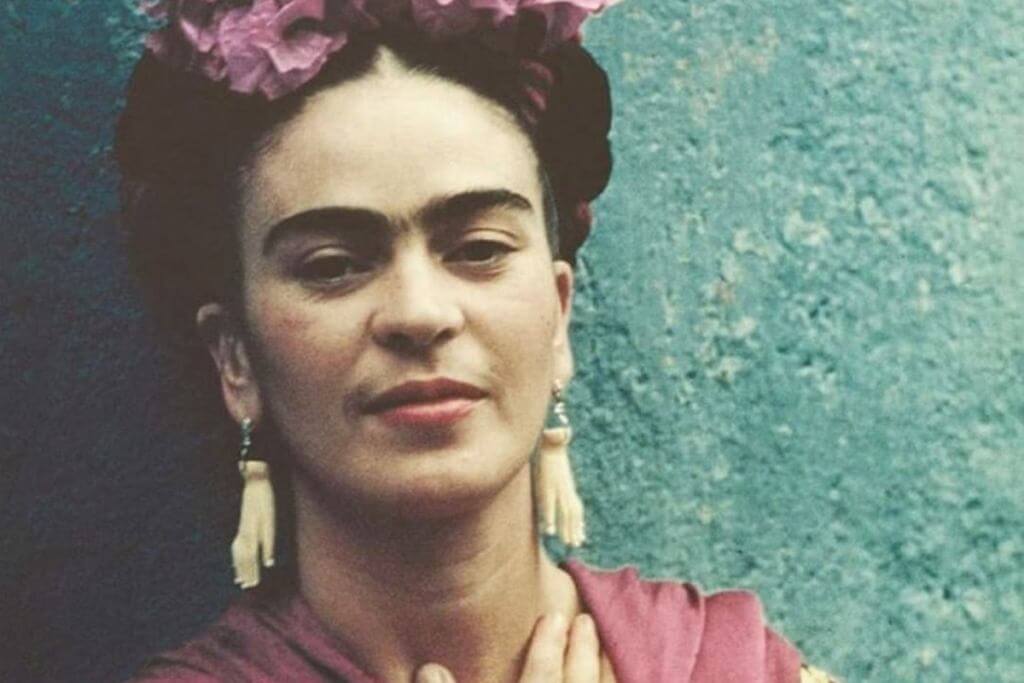
Frida Kahlo (1907–1954) was a Mexican painter known above all for her self-portraits, in which Mexican folk art and pre-Columbian imagery sit alongside a direct record of illness, loss and identity. In her lifetime she was seen mainly as Diego Rivera’s wife, and her reputation grew decades after her death; in 2025 her painting El sueño (La cama) (‘The Dream (The Bed)’, 1940) became the most expensive work by a woman ever sold at auction.
Frida Kahlo at a glance:
- A Mexican painter born on 6 July 1907 in Coyoacán, Mexico City, who grew up, lived and died at La Casa Azul, her family home and a museum since 1958.
- Polio at six and a bus crash at 18 left her in pain for life; she began painting in bed while recovering from the 1925 accident.
- Self-portraits are the core of her work, among them The Two Fridas (1939) and The Broken Column (1944), which draw on Mexican votive painting and on her own body.
- Her auction record, US$54.7 million for El sueño (La cama) at Sotheby’s New York in November 2025, is the highest price ever paid at auction for a work by a woman artist.
Who was Frida Kahlo?
Frida Kahlo was a Mexican painter, born Magdalena Carmen Frida Kahlo y Calderón on 6 July 1907 in Coyoacán, then a village on the outskirts of Mexico City. She grew up at La Casa Azul, the family house in Coyoacán, and spelt her first name ‘Frieda’ until the late 1930s, when she dropped the ‘e’ because she did not want to be associated with Germany under Hitler. From her school years onwards she gave her date of birth as 7 July 1910, placing it in the year the Mexican Revolution began, and she kept to that date for the rest of her life.

Her father, Guillermo Kahlo, was born Carl Wilhelm Kahlo in Pforzheim, Germany, in 1871 and emigrated to Mexico in 1891, where he took the Spanish form of his name and became a photographer of architecture, churches and industry. Kahlo described him as Jewish with roots in Hungary; German genealogists later established that his parents were Lutherans. He taught his daughter photography, including retouching, developing and colouring prints, and after she caught polio he encouraged her to take up sport, then thought unsuitable for girls. Her mother, Matilde Calderón y González, was born in Oaxaca to an Indigenous father and a mother of Spanish descent. Their relationship was tense, and Kahlo described her as ‘kind, active and intelligent, but also calculating, cruel and fanatically religious’.
Kahlo was the third of four daughters: Matilde and Adriana were older, Cristina younger. Two half-sisters from her father’s first marriage, María Luisa and Margarita, were raised in a convent. In 1922 she was accepted at the National Preparatory School (Escuela Nacional Preparatoria) in Mexico City, which had only recently begun to admit girls; there were 35 of them among 2,000 students. She studied natural sciences there with the aim of becoming a doctor.
How did polio and the 1925 bus accident affect Frida Kahlo?
Kahlo lived with pain from childhood. Polio, which she caught at the age of six in 1913, left her right leg shorter and thinner than the left, and a bus crash at 18 broke her spine and pelvis and caused medical problems for the rest of her life. As a child, the illness kept her away from other children for months and she was bullied; as an adult, she hid her limp and her thinner leg under long skirts from the Tehuantepec region.
On 17 September 1925 Kahlo and her boyfriend, Alejandro Gómez Arias, were travelling home from school when an electric tram crashed into the side of their wooden bus. Several passengers were killed. An iron handrail went through Kahlo’s pelvis and punctured her abdomen and uterus. Her spine was broken in three places, her pelvis and collarbone were fractured, her right leg was broken in 11 places, her right foot was crushed and dislocated, and her shoulder was dislocated. She spent a month in hospital and two months recovering at home. When the pain in her back persisted, X-rays showed three displaced vertebrae, and she had to wear a plaster corset that kept her in bed for most of another three months. The accident ended her plan to study medicine.

The injuries never fully healed. Kahlo had repeated operations on her spine, right leg and right foot, and in 1934 several gangrenous toes were amputated. In June 1945 she travelled to New York for an operation that fused a bone graft and a steel support to her spine; it did not succeed. Between 1940 and 1954 she wore 28 supportive corsets made of steel, leather and plaster, some of which she painted herself.
How did Frida Kahlo start painting?
Kahlo began to paint in 1925, while confined to bed after the accident. Her mother had a special easel made so that she could work lying down, her father lent her some of his oil paints, and a mirror was fixed above the easel so that she could see herself. She had already taken drawing lessons from the printmaker Fernando Fernández, a friend of her father, and earlier that year had worked for him as a paid engraving apprentice, although at the time she did not think of art as a career.

Her first paintings were portraits of herself, her sisters and her school friends, and her early pictures and letters show that she drew on Renaissance painters such as Sandro Botticelli and Bronzino. Self-Portrait in a Velvet Dress (1926) was her first self-portrait. She later explained the subject in one sentence: ‘I paint myself because I am often alone and I am the subject I know best.’ For a while she also considered a career as a medical illustrator, which would have combined her interests in science and art.
What was Frida Kahlo’s marriage to Diego Rivera like?
Kahlo married the muralist Diego Rivera twice, in 1929 and, after a divorce in 1939, again in 1940, and both had affairs throughout. She had first seen Rivera in 1922, when he was painting a mural at her school, and was introduced to him in June 1928 at a party given by the photographer Tina Modotti. Soon afterwards she asked him whether her paintings showed enough talent for her to become an artist, and the two began a relationship. Rivera was more than 20 years older. They married in a civil ceremony at Coyoacán town hall on 21 August 1929. Kahlo’s mother opposed the match, and both parents called it a marriage between an elephant and a dove because of the difference in their size; her father accepted Rivera, who could pay for her medical treatment.

From 1930 to 1933 the couple spent most of their time in the United States, where Rivera painted murals in San Francisco, Detroit and New York. In San Francisco Kahlo painted Frieda and Diego Rivera (1931), a double portrait based on their wedding photograph and the first of her works to be shown in an exhibition. Detroit was harder. She became pregnant, her doctor agreed to an abortion but the medication did not work, and in July 1932 she miscarried and spent two weeks in hospital; the experience became the subject of Henry Ford Hospital (1932). Her mother died in Mexico a few months later.
Back in Mexico City in 1934, the couple moved into two connected house-studios in San Ángel designed by Juan O’Gorman. Early in 1935 Kahlo discovered that Rivera was having an affair with her younger sister Cristina. She moved into a flat in central Mexico City, had an affair with the American artist Isamu Noguchi and was reconciled with both Rivera and Cristina later that year. After the couple petitioned the Mexican government to grant asylum to Leon Trotsky, he and his wife, Natalia Sedova, lived at La Casa Azul from January 1937 until April 1939. Kahlo and Trotsky had a brief affair, and on 7 November 1937, his birthday, she gave him Self-Portrait Dedicated to Leon Trotsky. Her relationship with the photographer Nickolas Muray, who photographed her in colour, lasted until 1939, when he ended it.
Rivera asked for a divorce that year, and it was granted in November 1939; according to their friends, the main cause was their mutual infidelity. Kahlo moved back to La Casa Azul but went on managing Rivera’s finances and correspondence, and in 1940 she painted Self-Portrait with Cropped Hair, showing herself in a man’s suit surrounded by the hair she had just cut off. Later that year the two were reconciled in San Francisco and remarried there in a civil ceremony on 8 December 1940. This time both kept more independence: La Casa Azul was their main home, while Rivera kept the San Ángel house as his studio and a second flat. In 1951 the photographer Gisèle Freund quoted Kahlo as saying that she had suffered two grave accidents in her life, the tram and Diego.
How did Frida Kahlo’s career develop in New York, Paris and Mexico City?
Kahlo’s international breakthrough came in 1938 and 1939, with her first solo exhibition in New York and a show in Paris. In April 1938 the French surrealist André Breton visited Rivera in Mexico, claimed Kahlo for the movement and described her work as ‘a ribbon around a bomb’. That summer the actor and collector Edward G. Robinson bought four of her paintings for US$200 each, her first significant sale. Breton also wrote to the dealer Julien Levy, who gave her a solo exhibition at his gallery on East 57th Street in Manhattan in November 1938. Despite the Great Depression she sold half of the 25 paintings on show, and new commissions followed, among them a portrait of the socialite Dorothy Hale for Clare Boothe Luce, which became The Suicide of Dorothy Hale.
In January 1939 Kahlo sailed to Paris for the exhibition Breton had promised, only to find that he had not collected her paintings from customs and no longer had a gallery. With help from Marcel Duchamp the show opened in March at the Renou et Colle gallery, where Breton hung her work alongside photographs by Manuel Álvarez Bravo and objects he had bought at Mexican markets. It lost money, partly because of the approaching war, and Kahlo cancelled a planned exhibition in London. The French state nevertheless bought her small self-portrait The Frame (1938), today in the collection of the Centre Pompidou. In Paris she met Pablo Picasso and Joan Miró, and the designer Elsa Schiaparelli created a dress inspired by her.
In the 1940s her standing in Mexico grew. In 1942 she became a founding member of the Seminario de Cultura Mexicana, and from 1943 she taught at the Escuela Nacional de Pintura, Escultura y Grabado, known as La Esmeralda; when her health made the journey difficult, she held classes at La Casa Azul. Four of her students, Fanny Rabel, Arturo García Bustos, Guillermo Monroy and Arturo Estrada, became known as ‘Los Fridos’. In 1946 she received a 5,000-peso national prize for Moses (1945), and in 1947 the Museo de Arte Moderno in Mexico City bought The Two Fridas.
How did Frida Kahlo die?
Frida Kahlo died at La Casa Azul on 13 July 1954, aged 47, after several years in which illness had kept her mostly in bed or in a wheelchair. Her nurse found her dead early that morning. The official cause of death was a pulmonary embolism; no autopsy was carried out, and her biographer Hayden Herrera has argued that Kahlo took her own life.
In 1950 she spent most of the year at the ABC Hospital in Mexico City, where a new bone graft on her spine led to an infection and to further surgery; she counted seven operations on her spine in that period. Afterwards she moved with a wheelchair and crutches and was mostly confined to La Casa Azul. She painted mainly still lifes of fruit and flowers, often with political symbols such as flags or doves, and her brushwork became faster and looser. In April 1953 the photographer Lola Álvarez Bravo gave her a first solo exhibition in Mexico, at the Galería Arte Contemporáneo. Kahlo’s doctors had ordered bed rest, so her four-poster bed was moved to the gallery, and she arrived by ambulance and was carried in on a stretcher. The same year the Tate Gallery’s exhibition of Mexican art in London included five of her paintings.
In August 1953 her right leg was amputated at the knee because of gangrene. She became severely depressed, and her dependence on painkillers grew. She was in hospital again in April and May 1954 but resumed painting that spring; her last works include the political Marxism Will Give Health to the Sick and the still life Viva la Vida (‘Long live life’, 1954). In her final days, ill with bronchopneumonia, she made one more public appearance, joining Rivera on 2 July 1954 at a demonstration against the CIA-backed invasion of Guatemala. The last words in her diary say that she awaited her departure joyfully and hoped never to return. Her body lay in state at the Palacio de Bellas Artes under a Communist flag, and after her cremation her ashes were placed in a pre-Columbian urn at La Casa Azul.

What defines Frida Kahlo’s painting style?
Kahlo painted mostly small self-portraits that combine realism with fantasy and draw on Mexican folk art, pre-Columbian mythology and Catholic imagery. Like many Mexican artists of her generation she was shaped by Mexicanidad, the post-revolutionary movement to define a Mexican identity, and from 1929, when she and Rivera lived in Cuernavaca, she turned increasingly to folk art. Her most direct model was the retablo, a small votive painting on tin made by an amateur artist to thank a saint for rescue from an illness or accident. Kahlo collected about 2,000 of them and hung them on the walls of La Casa Azul, and in the 1930s she painted mostly on small metal sheets herself. After her divorce in 1939 she moved to larger canvases, which were easier to exhibit.
Her paintings return to the same motifs. Monkeys, skeletons, skulls, blood and hearts come from Aztec mythology, roots grow from her body and tie it to the ground, and pairs of opposites such as life and death or Mexican and European appear side by side. Her face, much the same in every portrait, stays mask-like, while the objects, animals and wounds around it carry the meaning. Many of the animals were her own pets at La Casa Azul, which included spider monkeys, Xoloitzcuintli dogs, parrots and a deer called Granizo.

Kahlo’s clothes carried meaning too. From around 1929 she wore traditional Indigenous dress, above all the long skirts, huipils and headdresses of the women of the Isthmus of Tehuantepec, whose society was seen as matriarchal, and she painted herself in it as well as in a man’s suit or a European dress. Breton claimed her for surrealism and she took part in surrealist exhibitions, yet she rejected the label: ‘I never painted dreams. I painted my own reality.’ Art historians have proposed other categories: Andrea Kettenmann describes her as a symbolist, and Emma Dexter links her work to magical realism and New Objectivity.
Frida Kahlo’s legacy: her most famous paintings and where they are now
Most of Kahlo’s best-known paintings are in Mexico City. The largest collection belongs to the Museo Dolores Olmedo at the former La Noria hacienda in Xochimilco, which reopened on 30 May 2026 after almost six years and holds Henry Ford Hospital and The Broken Column. Other key works are in museums in San Francisco, New York, Washington, Austin and Paris, several remain in private collections, and one of her largest paintings has been missing since 1955.
| Painting | Year | Where it is |
|---|---|---|
| Frieda and Diego Rivera | 1931 | San Francisco Museum of Modern Art (SFMOMA) |
| Henry Ford Hospital | 1932 | Museo Dolores Olmedo, Mexico City |
| My Grandparents, My Parents, and I | 1936 | Museum of Modern Art (MoMA), New York |
| Self-Portrait Dedicated to Leon Trotsky | 1937 | National Museum of Women in the Arts, Washington, DC |
| What the Water Gave Me | 1938 | private collection |
| The Frame | 1938 | Centre Pompidou, Paris |
| The Two Fridas | 1939 | Museo de Arte Moderno, Mexico City |
| Self-Portrait with Cropped Hair | 1940 | Museum of Modern Art (MoMA), New York |
| Self-Portrait with Thorn Necklace and Hummingbird | 1940 | Harry Ransom Center, University of Texas at Austin |
| El sueño (La cama) | 1940 | private collection |
| The Wounded Table | 1940 | lost since 1955 |
| The Broken Column | 1944 | Museo Dolores Olmedo, Mexico City |
| The Wounded Deer | 1946 | private collection |
| Diego y yo (‘Diego and I’) | 1949 | Eduardo F. Costantini collection, Buenos Aires |
| Viva la Vida | 1954 | Museo Frida Kahlo (La Casa Azul), Mexico City |
The Two Fridas, painted in the year of her divorce, shows two seated versions of the artist, one in Tehuana dress and one in a European dress, with their hearts exposed. In The Broken Column her body is opened to reveal a broken column in place of her spine, with nails in her skin and a metal brace around her torso; by 1944 her doctors had recommended that she wear a steel corset. Henry Ford Hospital shows her on a hospital bed after the miscarriage in Detroit. El sueño (La cama), the record-breaking painting of 2025, shows her asleep in a four-poster bed floating in the sky, wrapped in vines, with a skeleton lying on the canopy; Kahlo kept a papier-mâché skeleton above her own bed. In The Wounded Deer, which she gave to her friends Arcady and Lina Boytler as a wedding present in 1946, her head sits on the body of a deer pierced by arrows.
The Wounded Table, more than two metres wide and the largest painting Kahlo made, was last seen at an exhibition of Mexican art in Warsaw in 1955. Kahlo had given it to the Soviet Union, and after the Warsaw show it disappeared; it remains the subject of an international search. When a Spanish dealer claimed in 2020 to have found it, Kahlo scholars, among them the art historian Susana Pliego, judged the work he presented to be a likely fake.
Why is Frida Kahlo so famous today?
Kahlo’s fame grew mostly after her death. In her lifetime she was known chiefly as Diego Rivera’s wife and as an eccentric personality in international cultural circles; from the late 1970s feminist art historians, who questioned the exclusion of women and non-Western artists from the art-historical canon, and the Chicano movement in the United States turned her into one of their figures. By the early 1990s the LGBTQ+ community had adopted her as well. Kirk Varnedoe, former chief curator of MoMA, said that she ‘clicks with today’s sensibilities’, pointing to her constant remaking of her own identity.
The first books on Kahlo appeared in Mexico in 1976 and 1977, and in 1978 she had her first retrospectives, at the Palacio de Bellas Artes in Mexico City and at the Museum of Contemporary Art in Chicago. Two events then took her to a wide public outside Mexico. In May 1982 the Whitechapel Gallery in London opened a joint exhibition of her paintings and Tina Modotti’s photographs, curated by Laura Mulvey and Peter Wollen, which travelled on to Sweden, Germany, the United States and Mexico. In 1983 the art historian Hayden Herrera published Frida: A Biography of Frida Kahlo, which became an international bestseller and later the basis of Julie Taymor’s 2002 film Frida. In 2001 Kahlo became the first Hispanic woman to appear on a US postage stamp, and in 2010 the Bank of Mexico issued a 500-peso note with Rivera on the front and Kahlo’s work on the reverse.
In 1984 Mexico declared her works part of the national cultural heritage and banned their export, so her paintings rarely come up for auction. In 1990 Diego y yo sold at Sotheby’s for US$1.43 million, the first time a Latin American artist passed the million-dollar mark at auction; in 2021 the same painting fetched US$34.9 million and went to the Argentine collector Eduardo F. Costantini. On 20 November 2025 El sueño (La cama) sold at Sotheby’s New York for US$54.7 million, overtaking the US$44.4 million paid in 2014 for Georgia O’Keeffe’s Jimson Weed/White Flower No. 1. The popular cult of the artist, from fan clubs to merchandise and fashion, has its own name, ‘Fridamania’, and has drawn criticism: the journalist Stephanie Mencimer wrote that Kahlo had become ‘a poster child for every possible politically correct cause’, and Peter Wollen compared her following to that of Sylvia Plath, whose work is often overshadowed by her life. In 2026 Tate Modern in London opened Frida: The Making of an Icon, organised with the Museum of Fine Arts, Houston, and on view until 3 January 2027, which traces how Kahlo became a global icon.
Casa Azul and Frida Kahlo’s other houses in Mexico City
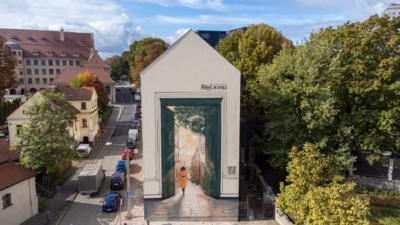
Kahlo spent most of her life in two houses in southern Mexico City: La Casa Azul in Coyoacán and the house-studio Juan O’Gorman designed for her in San Ángel. Both are now museums, as is Casa Roja, the Kahlo family house a short walk from La Casa Azul.
La Casa Azul, at Londres 247, was built in 1904 by Guillermo Kahlo in the style of the period, with rooms around a central courtyard and originally French-style decoration on the façade; its cobalt-blue walls later gave the house its name. Land next door was bought in 1937, while Trotsky was living there, and is now the garden. In 1946 Rivera asked O’Gorman to build Kahlo a studio and to close the courtyard with a new wing in local volcanic stone, decorated with shells and plant pots. After her death Rivera gave the house and its contents to Mexico, and it opened as the Museo Frida Kahlo in July 1958. Her studio is kept much as she left it, with her easel and paints, and visitors can see her bed, her corsets, her prosthetic leg and the urn with her ashes.
After Kahlo died, Rivera locked many of her belongings in a bathroom at La Casa Azul and asked that it stay closed until 15 years after his own death. It was opened only in 2004, and inside were more than 300 items, among them dresses, jewellery, corsets and orthopaedic devices. They were first shown at the museum in Appearances Can Be Deceiving: The Dresses of Frida Kahlo, which opened in November 2012, and in 2018 the V&A in London displayed them outside Mexico for the first time in Frida Kahlo: Making Her Self Up.

The San Ángel complex, designed by O’Gorman in 1931 and completed in 1932, is one of the first functionalist buildings in Latin America. It consists of two house-studios joined by a bridge, Kahlo’s painted blue and Rivera’s pink and white, together with a photographic laboratory for Guillermo Kahlo. The couple lived there from 1934 until their divorce in 1939, and Rivera kept his studio there until his death in 1957. Today it is the Museo Casa Estudio Diego Rivera y Frida Kahlo, restored to its 1932 state.
Museo Casa Kahlo opened on 27 September 2025 at Aguayo 54, in Casa Roja, the house where Kahlo’s parents and later her sister Cristina lived. It is run by Kahlo’s family and focuses on her childhood and family life, with letters, toys, photographs and personal belongings.
Frida Kahlo – frequently asked questions
Did Frida Kahlo have any children?
No. She had an abortion early in her marriage, lost a pregnancy in Detroit in 1932 and had two more abortions in 1934. Her letters show that she was ambivalent about motherhood.
Why is Frida Kahlo an LGBTQ+ icon?
Kahlo had relationships with both men and women and challenged gender norms by wearing men’s clothes, as she painted herself in Self-Portrait with Cropped Hair. In 2012 she was inducted into the Legacy Walk in Chicago, an outdoor display that celebrates LGBT history and people.
Was Frida Kahlo a communist?
Yes. She joined the Mexican Communist Party in 1927, left it in 1929 in support of Rivera, who had been expelled, and in 1936 joined the Trotskyist Fourth International. She later embraced Stalinism, rejoined the party in 1948 and campaigned for peace, collecting signatures for the Stockholm Appeal.
Who played Frida Kahlo in the film Frida?
Salma Hayek, who also co-produced Julie Taymor’s Frida (2002), with Alfred Molina as Diego Rivera. The film received six Academy Award nominations, including Best Actress for Hayek, and won for makeup and for Elliot Goldenthal’s score. In Paul Leduc’s Mexican film Frida, naturaleza viva (1983) Kahlo was played by Ofelia Medina.
La Casa Azul puts cobalt-blue walls, folk art, retablos and pre-Columbian figures in the same rooms. An interior built around one saturated colour and a large collection is easy to overload, so it pays to plan it with a designer before buying the first piece of furniture. Find architects, interior designers and interior photographers in the PLNDesign directory.
See also:
- Paul Gauguin: life, Tahiti and his most famous paintings
- Salvador Dalí: life, famous paintings and where to see them