

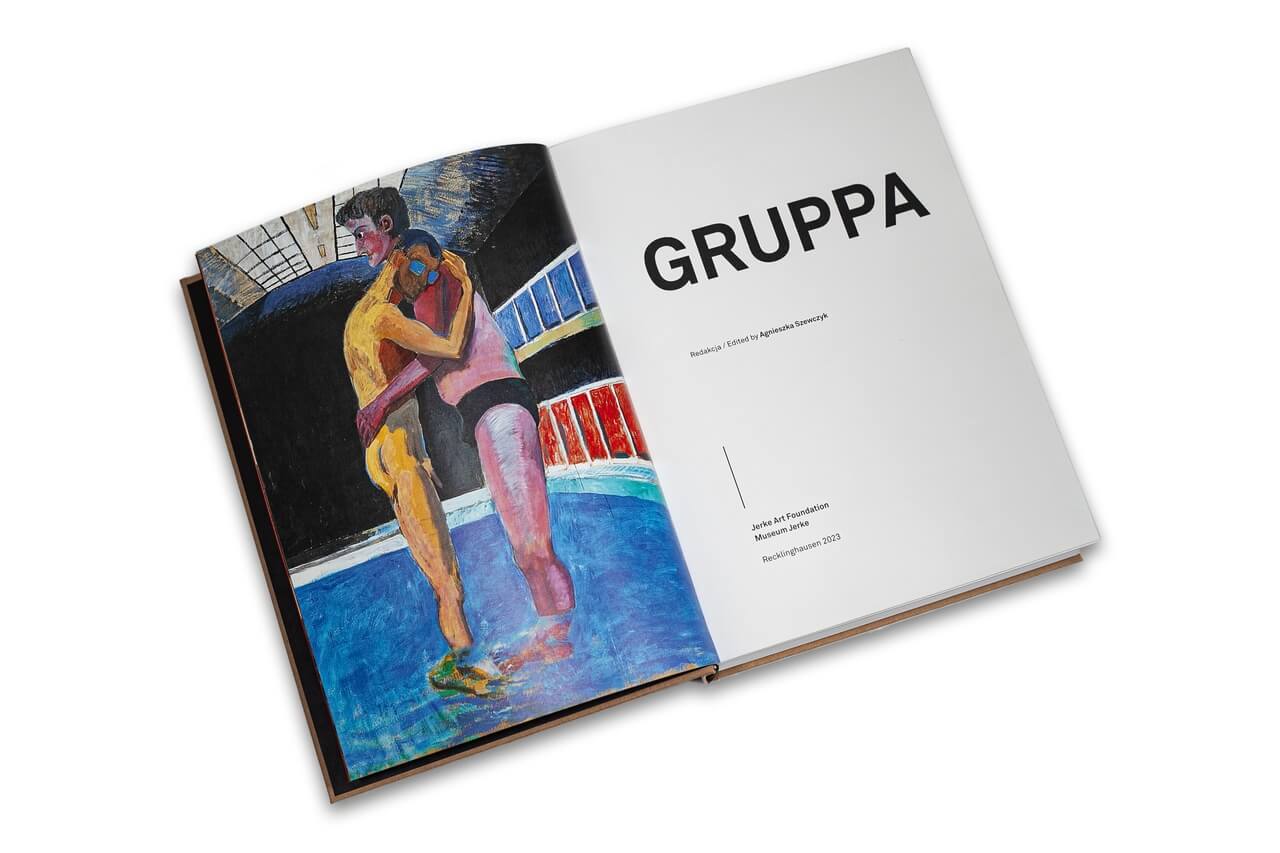
Against the grey of everyday life in communist Poland, the colours in Gruppa’s paintings seemed almost to shout. The painters’ taste for exaggeration and the grotesque grew out of their resistance to martial law and a need to give vent to the political pressures of the time. Published by Germany’s Jerke Art Foundation, the first comprehensive book devoted to Gruppa brings together the work of six artists whose individual styles could be strikingly different.
A group with two ps and no manifesto
Paweł Kowalewski and Ryszard Woźniak founded Gruppa in 1982, two years after the exhilaration that greeted the emergence of the Solidarity movement and a year after the imposition of martial law. Ryszard Grzyb, Włodzimierz Pawlak, Jarosław Modzelewski and Marek Sobczyk joined them. Maciej Wilski and Małgorzata (Kuka) Rittersschild also took part in several of their exhibitions and events.

“I remember the six of them turning up to see me sometime around the turn of 1982 and 1983 and announcing that they’d just formed a group,” recalled art historian, critic, curator and writer Anda Rottenberg. “The name? Well, a group was a grupa, only they’d spell it with two ps. They had no programme. They had no strategy mapped out. But who did back then? Only Grzyb piped up cheerfully, ‘We’re going to laugh!’”
Anarchy, provocation and bitter irony
Gruppa came to be seen as one of the defining expressions of Polish art in the 1980s. Its painters shared with their international contemporaries a search for a language of their own and a readiness to cross boundaries. They saw their circumstances as absurd and grotesque, a time stripped of genuine values. Freedom in their work took the form of anarchy, caustic provocation and bitter irony. The results were spectacular, yet the temperaments and interests of the six painters were too distinct to produce a uniform style.

“The emergence of Gruppa was one of the most important events in Polish art on the eve of its globalisation in the 1990s,” writes Stach Szabłowski in the book. “As an informal association that made a principle of having no programme, it was never a project. We might think of it as a space, both artistic and human, where painting talent, disparate inspirations, feelings and reflections reached critical mass, along with the need to experience artistic tradition and the equally urgent need to go beyond it.”
Between them, the artists produced several hundred paintings and more than a dozen printed publications, including nine issues of their own journal, Oj dobrze, już. They organised readings, poetry recitals and concerts. Among their last collective actions in 1989 was the painting of a fence outside the Niespodzianka café in Warsaw, which served as a Solidarity campaign club before that year’s historic elections.

Gruppa formally ended its activities with an exhibition at Zachęta in 1992, and the artists pursued their individual practices. A 2002 retrospective was titled Gruppa – przyznajemy się do winy, prosimy o wybaczenie, obiecujemy poprawę, a declaration of guilt, a plea for forgiveness and a promise to do better. The work has had a considerable influence on subsequent generations of Polish painters. It also bears witness to a particular time as six individuals experienced it.
A collector’s history of Gruppa
Although Gruppa was among the best-known phenomena of Polish art in the 1980s, a comprehensive study came much later. Its publisher, the Jerke Art Foundation, was founded by Werner Jerke, by then an observer and active participant in the Polish contemporary art scene for more than 35 years. His collection led to the opening in 2016 of a private museum in Recklinghausen, Germany, the first museum of Polish modern art outside Poland.

Born to a German family in Upper Silesia, Jerke was a contemporary of the Gruppa artists and left Poland in the early 1980s. He began collecting their work after they stopped working together. His growing interest led to his 2020 documentary Siła sztuki and then to the book.
Carefully balanced between essays and photographs, Gruppa is both a chronicle of the artists’ activities and a reference for researchers, collectors and art investors. Szabłowski examines the painting itself. Jakub Banasiak reconstructs its political, social and cultural setting, and Waldemar Baraniewski considers the artists’ statements of intent and reflections on their own practice. Rottenberg contributes a personal account as both witness and participant.

The book contains more than 300 reproductions and over 160 documentary photographs of the artists at work and together. It includes a chronology covering 1982–92 and a bibliography of the artists’ writings. The programme for the Polish launch at the Museum of Modern Art in Warsaw listed the Gruppa artists alongside Jerke, the book’s publisher.
“Many areas and questions remain to be explored, many actions to be interpreted,” writes editor Agnieszka Szewczyk in her introduction. “I firmly believe that the Jerke Art Foundation’s book on Gruppa is only the beginning.”
Art from the 1980s can be a starting point for an interior. Find an interior designer to help display a collection in the PLNDesign directory.
See also:
- Children remain calm amid the chaos of Guillermo Lorca García’s paintings
- Bill Mayer paints regal frogs and flowers with human faces