

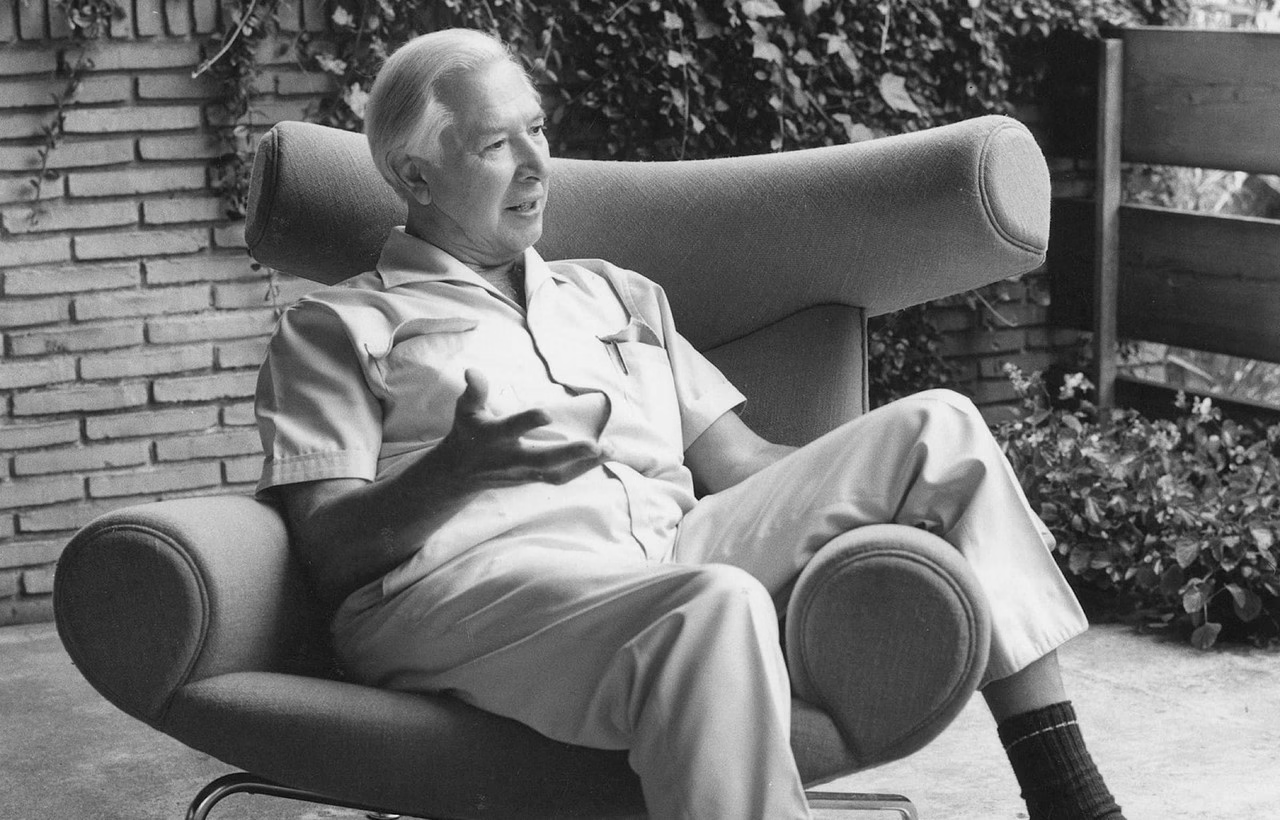
Hans Wegner (1914–2007) was a Danish furniture designer and trained cabinetmaker who designed more than 500 chairs, among them the Wishbone Chair and The Round Chair of 1949. Many of his designs are still made by Carl Hansen & Søn, PP Møbler, Fritz Hansen and Fredericia, and since April 2026 a museum devoted to his work has been open in Tønder, the town where he was born.
Hans Wegner at a glance:
- Born in Tønder on 2 April 1914, the son of a shoemaker, he was apprenticed to a cabinetmaker at 14 and worked mainly in solid wood throughout his career.
- His breakthrough came in 1949 with The Round Chair, known in the United States as The Chair, and the Wishbone Chair, which has been in continuous production since 1950.
- He shared the first Lunning Prize in 1951 and was made an Honorary Royal Designer for Industry in London in 1969.
- He retired in 1993 and handed his studio to his daughter Marianne. He died on 26 January 2007, aged 92.
Who was Hans J. Wegner?
Hans Jørgensen Wegner was a Danish furniture designer best known for his chairs in solid wood. He was born on 2 April 1914 in Tønder, in southern Jutland, a town that was then part of the German Empire. His father, Peter Mathiesen Wegner, was the local shoemaker, and the boy grew up around the tools of the workshop. He painted in watercolour, carved small figures with knives borrowed from his father and often visited the local art museum, where the porcelain figures of the Swedish artist Theodor Lundberg caught his eye. In the late 1920s, when a large house near the family home was pulled down, he got hold of some big pieces of oak and carved copies of several Lundberg figures from them.

How did Wegner become a furniture designer?
Wegner came to design through the workbench. At 14 he was apprenticed to the master cabinetmaker H. F. Stahlberg, made his first chair at 15 and finished his apprenticeship at 17 with a journeyman’s piece, a lady’s desk. During his military service he saw the 1935 exhibition of the Copenhagen Cabinetmakers’ Guild, and it convinced him to become a designer.

After the army he took a two-and-a-half-month cabinetmaking course at the Danish Technological Institute and then joined the furniture course at the School of Arts and Crafts in Copenhagen, where he was taught by Orla Mølgaard-Nielsen. He never went back to finish it, so he missed the final part, taught by Kaare Klint. In 1938 he showed his work at the Guild exhibition for the first time, with the Stangerup Chair.
What did Wegner design in the 1940s?
The 1940s turned Wegner from a cabinetmaker into a working designer. In 1938 he took a year off his studies to work on the furniture for Aarhus City Hall, designed by Arne Jacobsen and Erik Møller, and from 1939 to 1942 he was responsible for all of its furnishings. The Second World War delayed the City Hall, so he was first assigned to the Nyborg Public Library, where he designed chairs and stools, including a children’s chair. On 9 November 1940 he married Inga Helbo, a secretary in Jacobsen’s office, and in 1943 he left Jacobsen to open his own studio in Aarhus.
He also designed for FDB, the Danish cooperative, whose furniture department was run by his friend Børge Mogensen. In 1944, as a christening gift for Mogensen’s son Peter, he made Peter’s Chair from four pieces that fit together like a three-dimensional puzzle, with no glue or fasteners. It was sold through FDB and is still made by Carl Hansen & Søn. The same year FDB launched his J16 rocking chair, which has been in continuous production ever since and is now made by Fredericia. Also in 1944 came the China Chair for Fritz Hansen, the start of a series of chairs based on portraits of Danish merchants seated in Ming dynasty chairs.

In 1946 Wegner returned to Copenhagen to teach at the School of Arts and Crafts and, at the same time, worked in Palle Suenson’s studio on furniture for the M/S Venus, a ship damaged by the Germans during the occupation. A year later he designed the Peacock Chair for the master cabinetmaker Johannes Hansen, a reworking of the English Windsor chair. Wegner flattened the spindles of its fan-shaped back so that they would sit more comfortably against the shoulders, and the designer Finn Juhl, comparing the back to a peacock’s tail, gave the chair its name. In 1948 Wegner began to work with moulded plywood: he entered the Museum of Modern Art’s International Competition for Low-Cost Furniture Design, and Fritz Hansen put his first shell chair, the FH1936, into production.
How did the Wishbone Chair and The Chair make his name?
Two chairs from 1949 made Wegner known abroad. The Round Chair, made by Johannes Hansen, caught the attention of American journalists at that year’s Guild exhibition, and the magazine Interiors called it the ‘most beautiful chair in the world’. In the United States it became known as The Chair, and on 26 September 1960 John F. Kennedy and Richard Nixon sat in it for the first televised presidential debate. PP Møbler makes it today as the PP501, with a cane seat, and the PP503, with an upholstered seat.
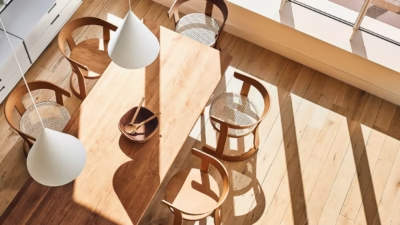
The Wishbone Chair, or CH24, was the first model Wegner designed exclusively for Carl Hansen & Søn, and the last chair in his series inspired by Ming dynasty chairs. Its steam-bent top rail forms the back and the armrests in one piece and is held steady by the Y-shaped back that gives the chair its name. Carl Hansen & Søn introduced it in 1950 and has made it without a break ever since. Each chair takes more than 100 production steps, most of them by hand, and a craftsman needs about an hour to weave the seat from roughly 120 metres of paper cord. The Wishbone became Wegner’s greatest commercial success.
Recognition followed quickly. In 1951 Wegner shared the first Lunning Prize with the Finnish designer Tapio Wirkkala and won the Grand Prix at the Milan Triennale. The same year Ejvind Kold Kristensen founded Salesco to market his work through five manufacturers: Ry Møbler, A.P. Stolen, Getama, Andreas Tuck and Carl Hansen & Søn. In 1953 Wegner spent three months touring the United States and Mexico. He turned down Raymond Loewy’s offer to move the production of his furniture to America and stayed with Edgar Kaufmann Jr at Fallingwater.
Why did sales of Wegner’s furniture in the US fall in the late 1960s?
The American market was hurt by a distribution deal and the prices that came with it. Georg Jensen Inc. in New York held the exclusive right to sell Salesco’s furniture in the United States and added a heavy premium to every Wegner piece, so American interior designers were asked to pay three to four times the Danish retail price. When Georg Jensen closed in 1968, Salesco’s five manufacturers were left with no distributor in the US. In 1969 Knoll took over the American distribution of the designs made by Johannes Hansen.

The same year Wegner’s partnership with Salesco broke down after a dispute with its managing director, Henning Foss-Pedersen. Salesco sided with Foss-Pedersen, and Wegner never worked with its companies again. He turned instead to PP Møbler, a workshop that had been making frames for his Papa Bear Chair since the 1950s. In 1969 he designed his first chairs for it alone, the PP201 and PP203, and urged Ejnar Pedersen to sell them under the PP Møbler name. He also designed the company’s logo and its marketing material for the next 20 years. In these years he turned more often to lighter-coloured woods, as foreign and exotic timbers fell out of favour with buyers.
What did Wegner do in his later years?
In 1973 Wegner brought his daughter Marianne, also a designer, into his studio. Two years later they designed the Wegner Lamp together, which won first prize in a Louis Poulsen competition and still lights the streets of Tønder. In 1975 he also designed the PP62 and PP52 Captain’s Chair. In 1978 PP Møbler delivered more than 600 special versions of the PP52 to the DFDS ferry Dana Anglia, which sailed between Esbjerg and Harwich. In 1982 a customer brought one of them to the workshop: he had found it one morning on a beach on Denmark’s west coast, its frame intact and only the seat missing, and he left with a new seat.
In 1990 Wegner and PP Møbler took over the Johannes Hansen collection of his designs from the 1950s and 1960s; Johannes Hansen himself had died in 1961. Wegner retired in 1993 and handed the studio to Marianne. He died on 26 January 2007, aged 92, and was buried at Mariebjerg Cemetery in Gentofte, under an engraved oak headstone made by Marianne and PP Møbler.
What was Hans Wegner’s design philosophy?
Wegner built his furniture from the craft up, with traditional joinery, natural materials and, above all, solid wood. He described the Danish style as a continuous process of simplification, which cut a chair down to four legs, a seat and a combined top rail and armrest. Many of his designs started from historical types, among them the Windsor chair and Chinese chairs, and he spoke of stripping these old chairs of their outer style so that only their construction remained. He also said that he had always wanted to make unexceptional things of exceptionally high quality, and that design did not always have to be ‘dreadfully serious’.

Which Hans Wegner chairs are still made today?
Wegner designed more than 500 chairs, and more than 100 of them went into series production. Many are still made by the companies that took over his work after the 1960s.
The upholstered Papa Bear Chair of 1951 was designed for A.P. Stolen and took its name from a critic who compared its arms to great bear paws embracing the sitter from behind. PP Møbler makes it today as the PP19. The Valet Chair began in 1951 with a conversation about folding clothes between Wegner, the architect Steen Eiler Rasmussen and the designer Kay Bojesen. King Frederik IX ordered one after seeing the first, four-legged version, which Wegner himself was not happy with. He spent about two more years refining it, and the king received a three-legged chair in pine with a teak seat, eventually ordering ten. The back of the PP250, as PP Møbler calls it, is shaped to hold a jacket, the hinged seat lifts so that trousers can be folded over it, and underneath is a compartment for keys and a wallet.
The Swivel Chair of 1955 was Wegner’s response to the doctor Egill Snorrason, who had criticised the Danish furniture trade for neglecting ergonomics. Its solid-wood top rail is twisted like a propeller and stands apart from the frame, and PP Møbler makes it as the PP502. The Ox Chair followed in 1960. A.P. Stolen produced it for only two years. In 1989 Wegner asked the manufacturer Erik Jørgensen to find a better way of building it, and Jørgensen proposed upholstery in foam rubber. Fredericia has made the chair since it took over Erik Jørgensen in October 2020.
Carl Hansen & Søn added more Wegner chairs to the Wishbone. The CH37 armchair of 1962, with its woven paper cord seat, draws on Shaker furniture. The CH07 Shell Chair of 1963 rests on three arched legs laminated from layers of veneer, with an upholstered seat and back in pressed veneer. Critics liked its avant-garde look, but buyers were not ready for it and only a few were made in the 1960s. Carl Hansen & Søn reintroduced it in 1998.
The Flag Halyard Chair of 1950, first made by Getama, began on a hot summer afternoon on the beach: while his children played in the water, Wegner shaped a seat in the sand and later sketched its angles at the family’s summer house. PP Møbler makes it as the PP225, with a stainless steel frame and about 220 metres of flag line forming the seat and back.

| Chair | Year | Made today by |
|---|---|---|
| J16 rocking chair | 1944 | Fredericia |
| Peter’s Chair (CH410) | 1944 | Carl Hansen & Søn |
| China Chair | 1944 | Fritz Hansen |
| Peacock Chair (PP550) | 1947 | PP Møbler |
| Wishbone Chair (CH24) | 1949 | Carl Hansen & Søn |
| The Round Chair, or The Chair (PP501, PP503) | 1949 | PP Møbler |
| Flag Halyard Chair (PP225) | 1950 | PP Møbler |
| Papa Bear Chair (PP19) | 1951 | PP Møbler |
| Valet Chair (PP250) | 1953 | PP Møbler |
| Swivel Chair (PP502) | 1955 | PP Møbler |
| Ox Chair | 1960 | Fredericia |
| CH37 armchair | 1962 | Carl Hansen & Søn |
| Shell Chair (CH07) | 1963 | Carl Hansen & Søn |
| Captain’s Chair (PP62, PP52) | 1975 | PP Møbler |
Where can you see Hans Wegner’s furniture?
Wegner’s furniture is on show in museums in Tønder, Copenhagen and New York. Museum Wegner opened in Tønder on 2 April 2026 at Hestholm, a historic marsh farm on the edge of the town. Its first phase, designed by the architecture practice COBE, has more than 800 square metres of exhibition space for a permanent exhibition on Wegner’s design process and changing shows, and a new wing is planned that would take the museum to about 5,000 square metres. In the town centre, Kunstmuseet i Tønder has shown the chairs Wegner gave it in a former water tower since August 1995. Its last opening day was 31 August 2026, and it is now closed for a major modernisation, with reopening planned for 2028.
In Copenhagen, Designmuseum Danmark marked his centenary in 2014 with Just One Good Chair, an exhibition of more than 150 original pieces that ran from 3 April to 2 November. Since 7 June 2024 its permanent exhibition DANISH MODERN has looked at what sets apart a Wegner chair, a Børge Mogensen sofa or a Verner Panton lamp, and his chairs stand in its tunnel of 125 chairs, which traces how Danish furniture drew on historical types from other countries. In New York, the Museum of Modern Art owns The Chair of 1949, made by Johannes Hansen in oak and cane and given to the museum by Georg Jensen Inc. In November 2026 it is on view on the fifth floor, in gallery 516.

| Place | City | What you can see | Status (November 2026) |
|---|---|---|---|
| Museum Wegner, Hestholm | Tønder, Denmark | Permanent exhibition on Wegner’s design process and changing shows | Open since 2 April 2026 |
| Kunstmuseet i Tønder, water tower | Tønder, Denmark | Chairs Wegner gave to the museum, on show since 1995 | Closed for modernisation since 1 September 2026, reopening planned for 2028 |
| Designmuseum Danmark | Copenhagen | Permanent exhibition DANISH MODERN with a tunnel of 125 chairs | Permanent exhibition, on show since June 2024 |
| Museum of Modern Art (MoMA) | New York | The Chair (1949), made by Johannes Hansen | On view, fifth floor, gallery 516 |
Hans Wegner – frequently asked questions
How can you tell if a Hans Wegner chair is real?
Knud Erik Hansen, chief executive of Carl Hansen & Søn, says an original always carries a label with the maker’s name and a small number showing that it was made in Denmark. Originals are made from oak, beech or American walnut, while copies are usually made from cheaper wood, so he suggests lifting the chair to feel its weight and turning it over to look at the underside. He advises buying from an authorised dealer that buys directly from the manufacturer.
How many chairs did Hans Wegner design?
More than 500, of which more than 100 were put into series production. Many of the best known, from the J16 rocking chair of 1944 to the Captain’s Chair of 1975, are still made today.
What was Hans Wegner’s favourite chair?
The Ox Chair of 1960 was one of his personal favourites, and he chose it to furnish his own home.
A Wishbone or a Round Chair is easiest to place well when the dining table, lighting and size of the room are planned around it from the start. Find architects, interior designers and interior photographers in the PLNDesign directory.
See also:
- Memphis Group: history, members and key designs
- Verner Panton: the Danish designer behind the Panton Chair