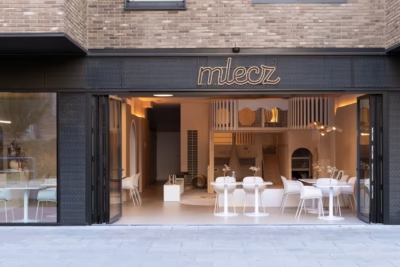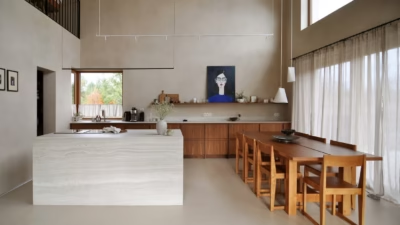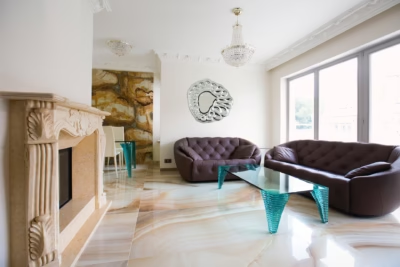


After 18 years of designing interiors from home, Agata Łysiak-Pisera decided to establish a separate office for her studio, Piętro Agata Łysiak. A graduate of the Strzemiński Academy of Fine Arts Łódź, she chose premises in a period building in Pabianice, Poland, combining its architectural character with personal keepsakes. As she puts it: “I simply ran out of room at home for all my samples.” Photography is by Piotr Walendziak.
Period details and personal choices
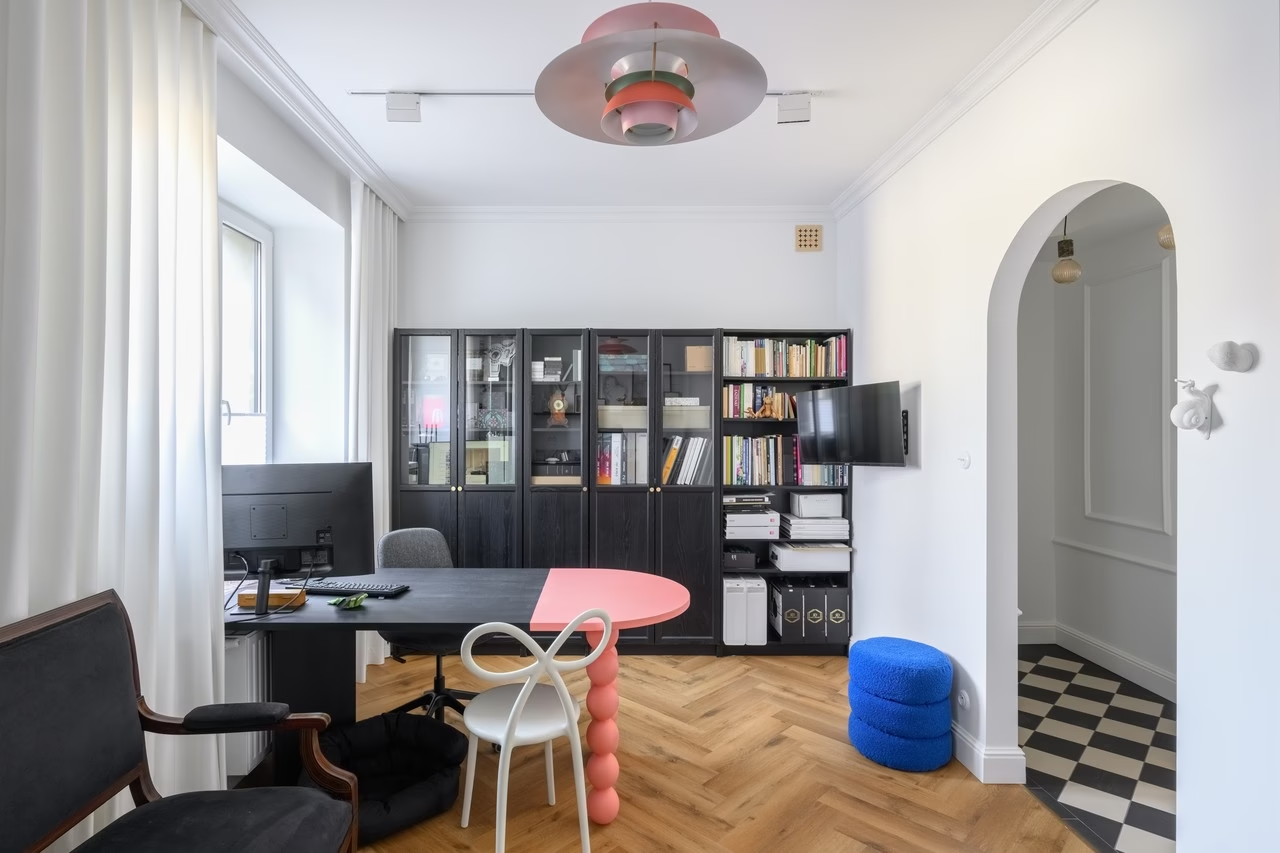
“When I bought the premises, it took me a long time to settle on a style,” says Łysiak-Pisera. “In the end, because the office is in a period building, I decided to respond to that context.” Existing arches between the rooms were retained, and the floor recalls the chequerboard pattern that once covered the stairwell before the developer removed it.

Dark wood lends warmth to a classic black-and-white palette and recalls older interiors. Colour and less expected combinations also appear, including a bespoke desk made by “the most wonderful joiner in the world, Mr Bogdan”, as the designer describes him with a smile.
A collection of miniature chairs
Miniature chairs collected over many years occupy a prominent place in the office. The collection reflects a longstanding passion, and the move finally gave the designer space to display her design pieces, antiques and paintings.
“I’m a great believer in having art in interiors. I think a home feels empty without pictures on the walls. And if those pictures have a history, so much the better,” she says.

A wall dedicated to a teacher
The most personal part of the office is a wall dedicated to Norbert Hans, a teacher who profoundly influenced Łysiak-Pisera’s artistic development. At its centre is his 1978 etching Kolekcjoner (“The Collector”), which she had looked at since childhood and which sparked her fascination with butterflies. They became so important to her that she once painted a self-portrait with a butterfly over one eye.

Another object is a small cast-brass turtle. Hans awarded these only to pupils who gained a place at art school or whose work demonstrated that they deserved to join this select group. Łysiak-Pisera has framed her pendant and hung it on the wall in his memory.
The display also includes a miniature violin bought at the Munich Philharmonic, a reference to Hans’s German family roots and his mother, who was a violinist. A paintbrush given to the designer by his children after his death completes the collection. “It paints in gold, because the values he passed on to me are worth more than gold,” she says, visibly moved.

Practical provisions
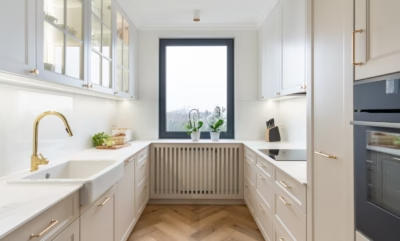
For all its personal associations, the office is first and foremost a working space. Its fully equipped kitchenette includes a fridge, a dishwasher and even room for an induction hob, “in case we need to turn the office into a flat for the grandchildren one day”, the owner jokes.

Arched doorways and rounded wall corners introduce curves throughout. “At one time they were considered a sign of bad taste, but now they’re coming back into favour,” the designer observes.
A renovation that took patience
The project was not without difficulties. “The biggest challenge was the fit-out team and the fact that the developer handed over the premises late, which significantly delayed the team’s start,” Łysiak-Pisera recalls. “They had to work overtime, and the renovation took more than six months.”

“It taught me patience, and I now approach my clients’ problems with greater empathy,” she says. Visitors often remark on how spacious the office feels despite its small size. For Łysiak-Pisera, its greatest advantages are its practical layout and the amount of space for the many samples she uses every day.

Recognition from the profession
Łysiak-Pisera is a member of the Association of Interior Architects (SAW), which brings together leading Polish design practices. “It is recognition of my work to date, my experience and my professional practice,” she says proudly. “Being part of SAW is a commitment to high ethical standards, high standards of work and continuing professional development.”

For her, interior architecture is a vocation. “Being an interior architect is a great responsibility. Shaping the spaces in which other people live must be done thoughtfully, with passion, but above all professionally,” she stresses. She also credits her clients for her admission to SAW: their needs come first, and working with them helps her develop every day.
Interested in Agata Łysiak-Pisera’s work? Discover more projects by Piętro Agata Łysiak and get in touch with the studio directly through its PLNDesign profile.
See also:
- The Design Group gives Yareal Polska’s Warsaw office a domestic feel
- SPACELAB gives GO PORT ŚREM fitness centre a domestic feel