

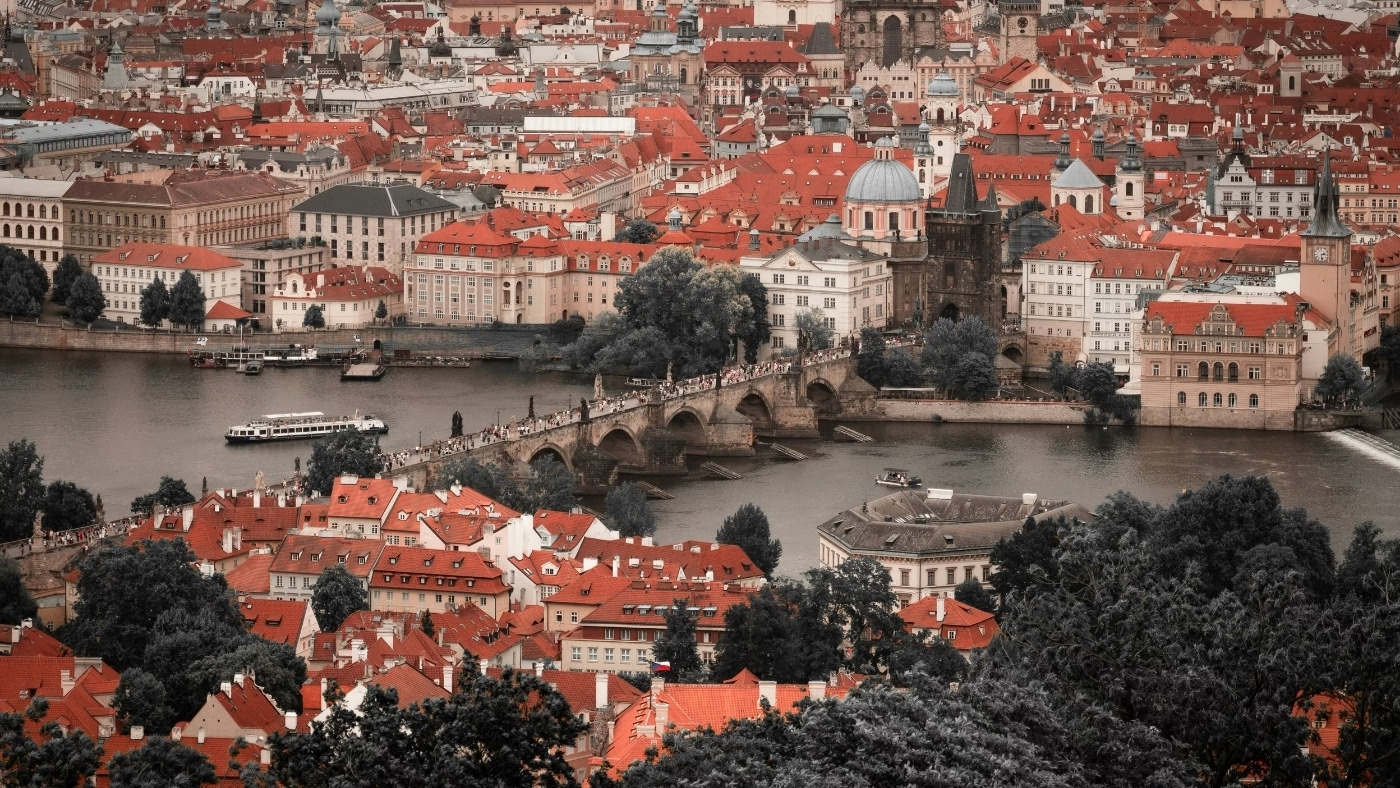
Charles Bridge is a Gothic stone bridge across the Vltava in Prague, linking the Old Town with Malá Strana, the Lesser Town. Built between 1357 and 1402 under Charles IV, it is the city’s oldest bridge, lined with 30 statues of saints and guarded by three towers. It is free to cross and open to pedestrians at any hour.
Charles Bridge at a glance:
- Built from 1357 to 1402 of sandstone blocks, it was the only crossing of the Vltava in Prague until 1841.
- Just under 516 metres long and 9.4–9.5 metres wide, it rests on 16 arches and has carried only pedestrians since the repairs of 1965–1978.
- Thirty statues and groups of statues were added between 1683 and 1928, starting with the bronze St John of Nepomuk.
- Only the towers and the museum charge admission: an adult ticket to the Old Town Bridge Tower costs CZK 250.
What is Charles Bridge and why is it famous?
Charles Bridge is Prague’s oldest bridge and, until the chain bridge of Emperor Francis I opened in 1841, it was the only way across the Vltava in the city. That made it the main link between Prague Castle and the Old Town. The bridge carried the trade route between western and eastern Europe and lay on the Royal Route, the path of the coronation processions of the Bohemian kings.
Today it is known above all for the 30 statues of saints along its parapet, which the Prague City Gallery, responsible for their care, describes as an open-air gallery of Baroque sculpture, and for the towers at either end. For centuries it was known as the Stone Bridge or the Prague Bridge, and it has been called Charles Bridge, after its founder, since 1870. In 1992 the Historic Centre of Prague, which includes the bridge, was inscribed on the UNESCO World Heritage List.

How big is Charles Bridge and how was it built?
Charles Bridge is 515.76 metres long and 9.4 to 9.5 metres wide, and its roadway runs 13 metres above the normal level of the river. It is built of sandstone blocks and rests on 16 arches carried by 15 piers, with spans of between 16.62 and 23.38 metres. Wooden ice guards protect the piers on the upstream side. The line of the bridge is not straight: it bends three times and bows slightly upstream.
The builders set out to avoid the weaknesses of the earlier Judith Bridge. The new bridge has fewer arches, stands higher, and its piers were founded deeper, about 2.4 metres below the riverbed. Each pier was built inside a cofferdam of timber piles and clay. Once the water had been pumped out, the ground was reinforced with driven piles and a timber grillage weighted with large stones shaped like millstones. Bedrock lies about nine metres below the riverbed, beyond the reach of medieval builders, and later floods showed that the foundations were still too shallow.

On the Malá Strana side the bridge passes over Kampa island, which can be reached by a stairway from the bridge, and one of its piers stands in the Čertovka, a side channel of the Vltava.
When was Charles Bridge built, and who designed it?
Construction began in 1357 under Charles IV, King of Bohemia and Holy Roman Emperor, and was completed in 1402. The 14th-century chronicler Beneš Krabice of Weitmile recorded that the emperor himself laid the foundation stone that year, on the riverbank near the monastery of St Clement. Charles IV died in 1378 and never saw the bridge finished.
It replaced the Judith Bridge, Prague’s first stone bridge, built between 1158 and 1172 under King Vladislaus II and named after his second wife, Judith of Thuringia. A flood on 3 February 1342 left it badly damaged, and for the next 15 years people crossed on a temporary wooden bridge or by boat. The new bridge was built slightly to the south. Parts of its predecessor survive, among them the lower of the two Lesser Town towers, which was the entrance to the Judith Bridge, and its last arch, under Křižovnické náměstí on the Old Town bank.
The bridge and the Old Town Bridge Tower were designed by Peter Parler, whom Charles IV brought to Prague in 1356 to take over the building of St Vitus Cathedral. In 2007 a hypothesis was published naming a different designer and first builder: Otto, also known as Otlin, a Prague stonemason and burgher.

The bridge was expensive, and collections were held in Prague churches to help pay for it. A toll for crossing on foot or by cart was charged until 1816. Shops and stalls once lined both ends of the bridge, and the last of them were removed in 1828.
What has happened to Charles Bridge since the Middle Ages?
Floods have damaged the bridge many times. In February 1784, rafts and ice blocked the arches and the water undermined the piers. The cutwater of the pier that carried a military guardhouse collapsed, and several piers were badly damaged. In September 1890, logs from broken rafts piled up against the bridge until part of it collapsed. Two statues by Ferdinand Maxmilian Brokoff, St Ignatius of Loyola and St Francis Xavier, fell into the river. The repaired bridge reopened on 19 November 1892. The 2002 flood caused only minor damage.
War left its mark too. On 21 June 1621, after the Battle of White Mountain, 27 leaders of the Bohemian revolt against the Habsburgs were executed in Old Town Square. Twelve of their heads were hung in iron baskets on the Old Town Bridge Tower as a warning and stayed there until the Saxon army entered Prague in 1631. In 1648, at the end of the Thirty Years’ War, Swedish troops holding the Malá Strana bank tried to break through to the Old Town across the bridge. The fighting badly damaged the river side of the Old Town Bridge Tower.
For most of its history the bridge carried ordinary city traffic. Horse trams crossed it from 1883, electric trams from 1905 and buses from 1908. Since the major repair of 1965–1978 it has been open to pedestrians only.
The most recent large repair was completed in 2010 and included new waterproofing, new paving and the replacement of many stones in the parapets. It was criticised. In October 2010 the National Heritage Institute said it could not consider the completed phase a success, and the UNESCO World Heritage Committee regretted that the restoration had gone ahead without proper conservation advice on materials and methods. A year later the committee commended the conservation measures taken in relation to the bridge.
What statues stand on Charles Bridge?
Thirty statues and groups of statues of saints stand on the parapet. They were added between 1683 and 1928, most of them in the early 18th century, and were paid for by different donors. The first was the bronze statue of St John of Nepomuk. The sculptors included Matthias Bernard Braun, Jan Brokoff and Jan’s sons Michael Joseph and Ferdinand Maxmilian Brokoff. Among the works are Braun’s St Luthgard, the Holy Crucifix and Calvary, and Braun’s St Ivo, commissioned by the law faculty of Charles University.

Many of the statues on the bridge today are copies. The damage done by the 1890 flood and the poor weathering of the Baroque sandstone figures led to copies being installed from the early 20th century. The copy of St Ivo dates from 1908, and the copy of St Francis Xavier, by Čeněk Vosmík, from 1913. The statue of St Ignatius was replaced by a group of Saints Cyril and Methodius by Karel Dvořák. The originals are kept in the Lapidarium of the National Museum at the Výstaviště exhibition grounds and in the Gorlice, an underground hall at Vyšehrad. The Prague City Gallery is responsible for the statues.
A 31st figure stands apart from the row: the knight Bruncvík, with a gold sword and a lion at his feet, on a pier by Kampa.
Why is St John of Nepomuk linked to Charles Bridge?
John of Nepomuk, vicar general to Jan of Jenštejn, Archbishop of Prague, was thrown from the bridge into the Vltava on 20 March 1393 on the orders of King Wenceslas IV. The king and the archbishop were in conflict, and in 1393 Wenceslas wanted to take over the revenues of the Benedictine abbey at Kladruby, which Jenštejn opposed. John and others from the archbishop’s circle were arrested and tortured. His body was found three days later and buried in St Vitus Cathedral.
The better-known version of his death, in which he refused to reveal the queen’s confession to the king, first appears in Thomas Ebendorfer’s chronicle of 1459, 66 years after his death. John of Nepomuk was beatified in 1721 and canonised in 1729, and he is the patron saint of bridges, of confessors and of people in danger from water.

His statue on the bridge was put up in 1683 to mark what was then taken to be the 300th anniversary of his death, dated at the time to 1383. Jan Brokoff carved a wooden model after a clay sketch by Matthias Rauchmiller, and the statue was cast in bronze in Nuremberg. Its figure of a priest holding a crucifix, with a halo of five stars, became the model for most later statues of the saint. There are around 6,000 of them in the Czech Republic alone, most of them on bridges. A small cross set into the parapet, with a wrought-iron grille, marks the traditional site of his fall.
What do people touch on Charles Bridge for luck?
Visitors touch the two bronze reliefs on the base of the St John of Nepomuk statue. One shows the saint being thrown into the river, and the other includes a dog. By Prague tradition, touching the first brings you back to Prague and stroking the dog brings luck. Constant touching has rubbed both spots to a golden shine. The reliefs left the bridge for the first time in 2010, when they were displayed at the Czech pavilion at Expo 2010 in Shanghai.

What are the towers at each end of Charles Bridge?
The Old Town Bridge Tower guards the Old Town end. Designed by Peter Parler in the mid-14th century, it was conceived as a triumphal arch through which Bohemian kings passed in their coronation processions. Unusually for a bridge tower, it stands on the first pier of the bridge rather than on the bank. Its facade carries statues of Charles IV and Wenceslas IV with St Vitus between them and saints Adalbert and Sigismund above. Lower down is a kingfisher framed by a twisted bath towel, the personal emblem of Wenceslas IV. A climb of 138 steps leads to the viewing gallery.
At the Malá Strana end, two towers of different heights are joined by a gate. The lower one, Judith’s Tower, is Romanesque and dates from the 12th century. Its Renaissance appearance dates from 1591. Judith’s Tower is closed to the public. The taller Late Gothic tower was built in 1464, modelled on Parler’s Old Town tower, and has a viewing gallery open to visitors.
Is Charles Bridge free, and when is the best time to visit?
Crossing Charles Bridge is free. There are no gates or opening hours, and the bridge is open to pedestrians day and night. Tickets are needed only for the two bridge towers, run by Prague City Tourism, and for the Charles Bridge Museum. Prague City Tourism is changing some tower prices on 1 March 2027.
| Bridge tower tickets (CZK) | Until 28 February 2027 | From 1 March 2027 |
|---|---|---|
| Old Town Bridge Tower, adult | 250 | 250 |
| Old Town Bridge Tower, reduced (ages 6–15, 65+) | 170 | 170 |
| Old Town Bridge Tower, family (2 adults, up to 4 children) | 500 | 540 |
| Lesser Town Bridge Tower, adult | 200 | 200 |
| Lesser Town Bridge Tower, reduced (ages 6–15, 65+) | 130 | 130 |
| Lesser Town Bridge Tower, family (2 adults, up to 4 children) | 400 | 440 |
| Both towers, adult | 340 | 360 |
| Both towers, reduced | 230 | 240 |
| Both towers, family | 680 | 770 |
Visitors aged 16 to 26 pay CZK 200 for the Old Town tower and CZK 160 for the Lesser Town tower, and children up to five go free. Every ticket is half price in the first hour after opening. Both towers open daily: 10am–6pm from January to March and in October and November, 10am–7pm in April and May, 9am–8.30pm from June to September and 10am–7.30pm in December.

The Charles Bridge Museum at Křižovnické náměstí 3, at the Old Town end, occupies part of the monastery of the Knights of the Cross with the Red Star. Its exhibition covers the Judith Bridge, the medieval masons’ lodge and the statues on the bridge, and includes a large model of the bridge under construction. Admission is CZK 220, reduced CZK 110. The museum opens daily from 10am to 7pm from May to September and from 10am to 6pm from October to April.
The bridge is busiest from mid-morning to late evening, so early morning is the quietest time to cross. The painters, photographers and musicians who work on the bridge have, since 1990, been selected in regular tenders by the Association of Charles Bridge Artists.
Two events are tied to the bridge. On 15 May, the eve of St John of Nepomuk’s feast, the Navalis festival brings a procession from St Vitus Cathedral across the bridge to Křižovnické náměstí, a regatta of historic boats and a Baroque concert on the river. The festival revives Baroque celebrations of the saint and has been held in its current form since 2009. Gas lamps returned to the bridge in 2010, and there are 46 on the bridge and Křižovnické náměstí. They light automatically for most of the year, but during Advent a lamplighter in historical uniform lights them by hand at dusk.
What legends and myths surround Charles Bridge?
The best-known legend concerns the foundation stone. According to it, Charles IV laid the stone on 9 July 1357 at 5.31am, a moment chosen by court astrologers because the digits 1-3-5-7-9-7-5-3-1 read the same in both directions. The date of 9 July first appears in a 16th-century chronicle by Prokop Lupáč, and the time of 5.31am in a 1979 hypothesis by the Czech astronomer Zdeněk Horský, who linked it to a favourable conjunction of the Sun and Saturn.
A second story holds that the builders mixed eggs into the mortar. In 2008 Czech chemists announced that an analysis of the original mortar had confirmed it. In early 2010 researchers from the University of Chemistry and Technology, Prague withdrew that conclusion and said that no eggs had been used.
On the Old Town side, a small stone head known as Bradáč, the Bearded Man, is set into the riverside wall. It comes from the Judith Bridge, where it served as a water gauge, and according to Prague legend a flood is coming when the water reaches his beard.

The knight Bruncvík on the pier by Kampa belongs to a legend about a magic sword that struck off his enemies’ heads at a word. Legend places the sword inside one of the bridge piers. When the Czech lands are at their worst, the knights sleeping in Blaník mountain will wake and ride to Prague’s aid.
Another story tells of a builder who, unable to repair a broken arch, promised the devil the soul of the first living thing to cross it. He planned to send a cockerel over first, but the devil, disguised as his assistant, told the builder’s wife her husband had been hurt, and she ran across the bridge ahead of the bird. The Old Town Bridge Tower has a legend of its own: only someone pure of heart can spot all five of its stone kingfishers at once.
Charles Bridge is Prague’s oldest bridge but not the oldest in the Czech Republic. The Stone Bridge in Písek, South Bohemia, built before the end of the 13th century, is at least half a century older, and in Central Europe only the Stone Bridge in Regensburg, Bavaria, predates Písek.
Charles Bridge – frequently asked questions
How old is Charles Bridge?
Construction began in 1357 and was completed in 1402, so the bridge is more than 600 years old. Charles IV laid the foundation stone himself.
How do you get to Charles Bridge?
On the Old Town side, the nearest stops are Staroměstská, served by metro line A and trams, and the Karlovy lázně tram stop. On the Malá Strana side, the nearest tram stop is Malostranské náměstí.
Which films were shot on Charles Bridge?
The bridge is among the Prague locations of Mission: Impossible (1996) and xXx (2002). In Mission: Impossible it is where Jim Phelps, played by Jon Voight, falls into the Vltava.
What is there to see near Charles Bridge?
On the Malá Strana side, Kampa island, the John Lennon Wall, Malostranské náměstí and the Church of St Nicholas are a short walk away. At the Old Town end, Křižovnické náměstí leads to the Clementinum, with its astronomical tower and Baroque library.
Many of the statues on Charles Bridge are now copies because the sandstone originals could not withstand more years outdoors. Choosing materials for the conditions they will actually face matters just as much on the facade of a period building or in a listed interior. Find architects, interior designers and interior photographers in the PLNDesign directory.
See also:
- Sydney Opera House: Utzon’s design, history and how to visit
- Palace of Versailles: history, architecture, gardens and how to visit