

Among timber, rattan furniture and warm beige tones, a mandala stands out as a symbol of harmony, transcendence and inner calm at Quantum. Joanna Ochota has transformed the interior into a place for meditation, meetings with therapists and therapy in water. The space is intended to inspire and motivate, much like its owner. It was photographed by Jaga Kraupe.
A project that arrived at the right time
“Everything in life has its place and its time” is a sentiment that Joanna Ochota, the designer of Quantum, has come to appreciate. She says the invitation to design the space arrived at the right moment. Despite her many years of practice, she believes she would not have been ready for the challenge earlier. In her view, Quantum required not only design skills but, above all, a deep understanding of its purpose.

Earth tones, curved forms and a ceiling mandala
Quantum combines meditation with practical design. Previously, it resembled a conventional 1950s flat, without a division into shared living and private areas. Ochota turned it into a contemporary setting for meditation, consultations with therapists and therapy in water. The interior is bright, cosy and comfortable, with an atmospheric quality that makes a visit an exploration of contemporary design as well as an inward journey.

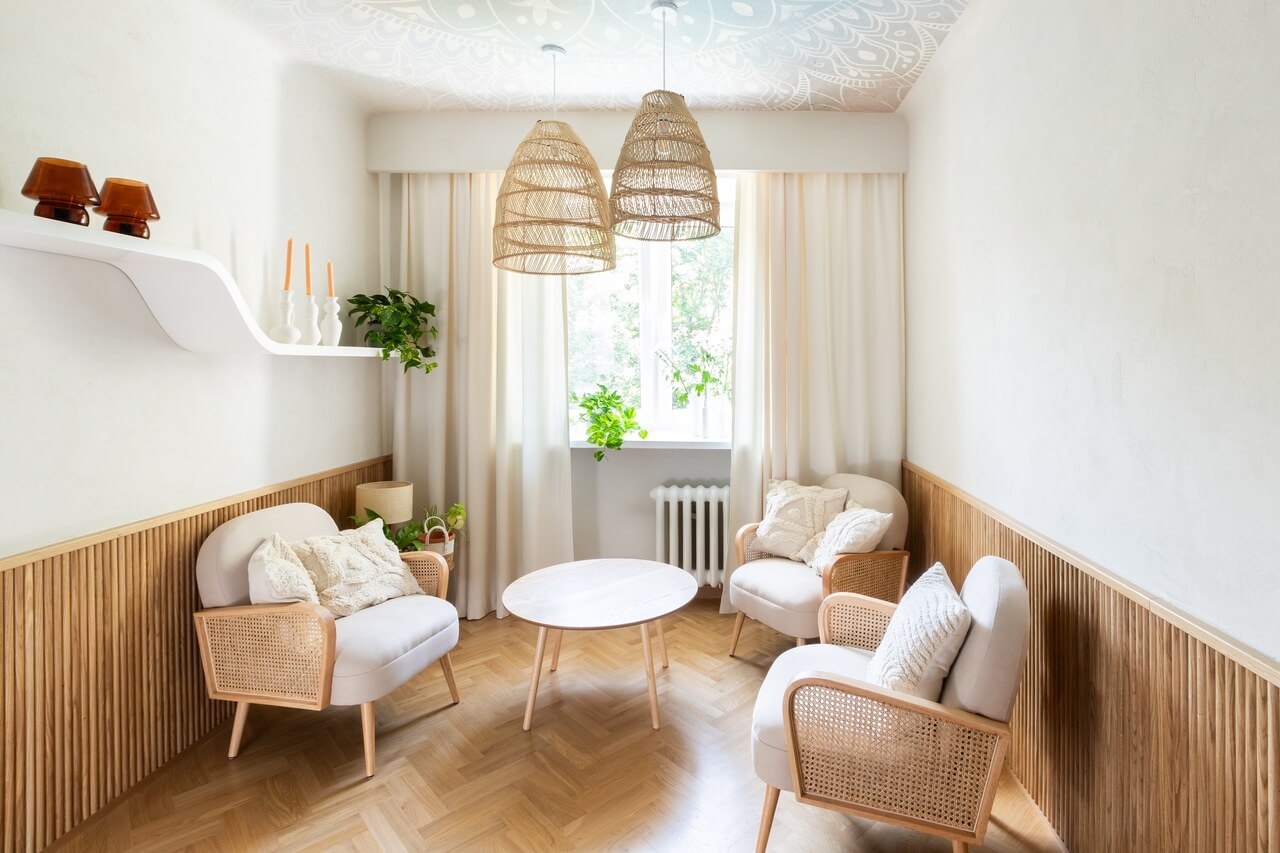
The space feels generous yet cosy, thanks to a carefully chosen palette. Earthy shades dominate, with warm beige and brown contrasted by blue. Timber flooring is laid in a classic herringbone pattern. Details reveal an interest in Hindu tradition through the ceiling mandala, while a wardrobe, chairs and a wall niche in the corridor introduce rounded forms. Mirrors make the space feel larger and carry a symbolic meaning: destiny, revelation, self-knowledge, knowledge, truth and self-realisation, all connected to the reasons people come here.
The mandala greets visitors at the entrance and extends across the ceiling throughout the former flat, connecting the different areas. It is placed overhead because visitors will look upwards more often here than they usually would. Associated with tantric Buddhism, mandalas were used in meditation, with the act of drawing one helping to achieve concentration. Symbolically, this marked the beginning of the circle of life. Blue represents the sky, permanence, constancy and fidelity. Pink also appears, although it was not planned, bringing associations of affection and gratitude.

A restrained setting for concentration
The therapy area is the most austere part of the interior, deliberately designed to encourage calm and concentration. It hosts meditation for a few people as well as group sessions. The room contains no furniture or accessories [?]. Large upholstered wall panels improve the acoustics and reduce reverberation, helping create a setting suited to concentration.
Coloured-glass tables and comfortable pouffes complement the colours of the panels, rug and curtains. The lighting is minimal but carefully designed. It supports the intended atmosphere of relaxation and focus.

The kitchen is for the therapists and was designed around comfort and ease of use. Bespoke units and a round table with four chairs provide a place to share meals and build relationships. A copper-toned mirror surround frames the window, creating an impression of infinity and suggesting the depth of meditation. A trellis with plants adds a natural element and contributes to the relaxing atmosphere. These apparently ordinary finishes carry deeper meanings within the design and are intended to support meditation.
The bathroom is used for individual therapy sessions. It contains a comfortable bath, microcement and plaster finishes on the walls and floor, two rounded niches with mirrors, copper fittings, woven lampshades and timber elements. The scheme refers to Zen philosophy, using simplicity and natural materials to create a setting for meditation and deep relaxation.
Spaces for meditation and therapeutic work need careful consideration of light, acoustics and comfort. Explore more projects by Joanna Ochota of Concept JOana on her PLNDesign profile and get in touch by email, phone, website or social media, whichever suits you best.
See also:
- After 18 years at home, a designer opens her own studio in Pabianice, Poland
- A Poznań osteopath’s clinic uses warm tones to put patients at ease